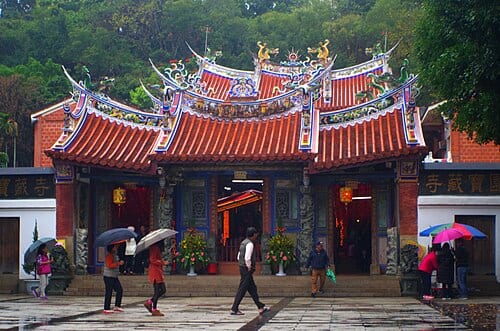
Fenyuan Baozang Temple is a Qing-dynasty temple in Fenyuan Township, Changhua County, built in 1672 during the Kangxi reign. It is one of central Taiwan's celebrated "Three Rock Temples and Two Temples," now designated a Changhua County historic site. Set against the eastern slopes of Baguashan facing the Maoluo River valley and Jiujiu Peak, its front hall preserves delicate clay-sculpted dragon-and-tiger reliefs, making it a pilgrimage site combining Qing temple architecture with natural landscape.
Fenyuan Baozang Temple was founded in 1672 (the 11th year of the Kangxi reign); according to the temple's own stele records it began as a small shrine to Guanyin. In 1985, Taiwan's Ministry of the Interior designated it a third-grade historic site of the Taiwan-Fujian region; it is now a Changhua County-designated historic site. Together with Lugang Longshan Temple, Huatan Hushan Rock Temple, Shetou Qingshui Rock Temple, and Nantou Bishan Rock Temple, it is counted among central Taiwan's "Three Rock Temples and Two Temples."
What to see at Fenyuan Baozang Temple
Baozang Temple is dedicated primarily to Guanyin Bodhisattva and has stood for more than 350 years, having been rebuilt multiple times while retaining its original layout. The temple is built in tiers following the mountain terrain. The clay-sculptured dragon-and-tiger panels on the facade of the front hall are vividly colored and finely crafted, representing the typical skill of Qing-dynasty artisans. As a county-designated historic site, repairs to the temple follow cultural heritage preservation standards, and many of the architectural components retain their historic character.
From the hillside behind the temple you can look down into the Maoluo River valley, with Jiujiu Peak in Nantou County directly across — the bare rocky faces of that cluster of peaks became even more pronounced after the 921 Earthquake of 1999, and they are clearly visible right from the temple forecourt. The surrounding woodland is dense, birds and cicadas fill the air, and temperatures are cooler than the plain below. The visit combines religious worship with a foray into the hills.
How to make the most of your visit
Practical information
Getting there & timing
- There is no direct bus service. Driving is recommended: take Provincial Highway 14 east from Changhua City, then follow the signs up the hill after reaching Fenyuan Township. The mountain road is single-lane — watch for oncoming vehicles.
- The temple is open year-round. Incense burning is typically heaviest from around 6 a.m. to 6 p.m. Visiting in the morning is recommended to avoid midday heat.
Nearby connections
- The itinerary can extend to the Jiujiu Peak Nature Reserve in Nantou County — head east along Highway 14 from the temple, about 20 minutes by car.
- Fenyuan Township has several lychee orchards; the summer fruit-picking season (June to July) offers the chance to add an agricultural activity to the trip.
Source: Changhua County Culture Bureau county-designated historic site registration records, Taiwan Religious Culture Map.
Frequently Asked Questions
When was Fenyuan Baozang Temple built?
Fenyuan Baozang Temple was built in 1672, during the 11th year of the Kangxi reign, making it one of central Taiwan's oldest temples.
What historic site status does it hold?
It was designated a third-grade historic site by Taiwan's Ministry of the Interior in 1985 and is now listed as a Changhua County historic site.
What are the "Three Rock Temples and Two Temples"?
The term refers to five Qing-dynasty temples in central Taiwan: Hushan Rock, Qingshui Rock, and Bishan Rock temples, plus Baozang Temple and Lugang Longshan Temple.
Sources
- 彰化縣定古蹟芬園寶藏寺官網-寶藏寺沿革 — 官方沿革頁,載明康熙11年創建與1985年古蹟評定
- 芬園寶藏寺-臺灣宗教文化地圖 — 內政部民政司宗教文化地圖,交叉核對沿革與三巖二寺說法