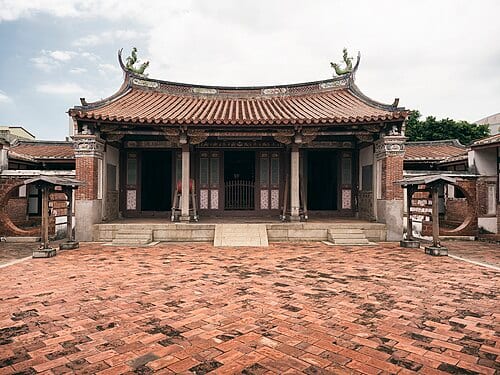
Hemei Daodong Academy is a Qing-dynasty academy in Changhua County's Hemei Township, first built in 1857 and completed the following year. Designated a historic monument in 1985 and now classified as a National Historic Site, it is among the best-preserved academy buildings surviving in Taiwan. Its two-courtyard layout comprises a front hall and a main hall; the main hall serves as the lecture hall and enshrines a tablet of Zhu Xi — hence its alternate name, Zhuzi Shrine — while the character-respecting pavilion separately honors Wenchang Dijun and Cangjie. Old trees fill the courtyard, and the restored complex covers roughly 2,500 ping (about 8,264 square meters), making it a valuable example for studying Qing-dynasty academy architecture and Confucian education history in central Taiwan.
Daodong Academy was founded in 1857 (Xianfeng 7) and completed the following year; it was designated a historic monument in 1985 and is now classified as a National Historic Site. Its architecture follows a two-courtyard layout comprising a front hall and a main hall; the main hall doubles as the lecture hall and enshrines a tablet of Zhu Xi, giving rise to its alternate name Zhuzi Shrine, while the character-respecting pavilion separately honors Wenchang Dijun and Cangjie. The restored complex covers approximately 2,500 ping (about 8,264 square meters).
Highlights of Hemei Daodong Academy
The academy's architecture follows a three-courtyard, two-wing layout, with the front hall, the central hall (lecture hall), and the rear hall (Wenchang Hall) arranged in a longitudinal line, and east and west wing rooms on either side that served as living quarters for teachers and students. The overall proportions of the academy are upright; the primary building materials are blue brick and fir timber. The ridges curve up with refinement, and the wood carvings are concentrated on the roof framing of the central hall, with subject matter drawn largely from Confucian stories. Several century-old banyan trees in the courtyard provide natural shade, lending the academy a quiet reading-room atmosphere.
The main functions of a Qing dynasty academy included hiring instructors to teach, funding candidates for imperial examinations, and organizing local cultural activities. Daodong Academy repeatedly organized review courses for the provincial examination during the Qing dynasty, drawing distinguished teachers. Today the academy is regularly open for visitors; some wing rooms have displays of historical and cultural material explaining Daodong Academy's role in the history of education in the Changhua region. The academy's outer wall and surroundings are relatively low-key — follow the directional signs to find the main entrance.
Tips for Getting the Most Out of Your Visit
Practical Information
Getting There & Visiting Hours
- Hemei Township has no train station. Driving is recommended, or take a bus from Changhua to Hemei and then a taxi or shared scooter to the academy.
- The academy is regularly open for visits; check the Changhua County Cultural Affairs Bureau or Hemei Township Office for exact opening hours. Admission is free.
Nearby Connections
- Hemei Township is known for its weaving industry; some textile factory sites remain in the township and can be visited in connection with understanding Taiwan's postwar light-industrial development.
- Driving east for about 20 minutes reaches Changhua Roundhouse or Changhua Confucius Temple, linking to the Changhua City cultural attractions.
Sources: Cultural Heritage Bureau, Ministry of Culture; Changhua County Cultural Affairs Bureau.
Frequently Asked Questions
When was Daodong Academy built?
Daodong Academy was founded in 1857 (the 7th year of the Xianfeng reign) and completed the following year.
Which deity does Daodong Academy enshrine?
The main hall of Daodong Academy doubles as its lecture hall and enshrines a tablet of Zhu Xi, giving it the alternate name Zhuzi Shrine, while the character-respecting pavilion separately honors Wenchang Dijun and Cangjie.
What heritage designation does Daodong Academy hold?
Daodong Academy was designated a historic monument in 1985 and is now classified as a National Historic Site, one of the best-preserved academy buildings in Taiwan.
Sources
- 道東書院 (臺灣) - 維基百科 — 建築格局為二進一院、正殿主祀朱子牌位、創建於1857年
- 國定古蹟環景導覽-道東書院|文化部文化資產局 — 官方導覽確認創建年代與建築格局