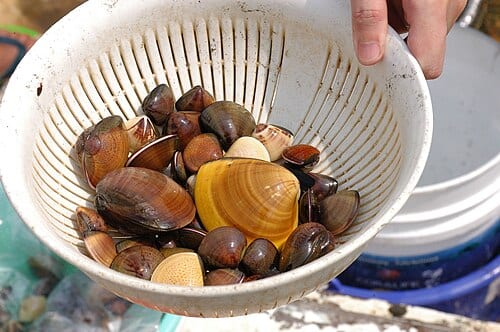
Kouhu hard clams are the farmed shellfish raised in Kouhu Township, Yunlin County. Government and media statistics show that roughly three out of every five hard clams sold in Taiwan come from Yunlin County, with Kouhu the township with the largest clam farming scale in the county. Local farms pump seawater directly into their ponds, producing thin-shelled, meaty clams, with peak richness from June to September.
Reports from Agri-Harvest (農傳媒) and China Times indicate Yunlin County's hard clam farming area totals roughly 3,500 hectares, concentrated in Taixi and Kouhu townships, with annual production of about 32,000 metric tons — around half of Taiwan's national total. Kouhu Township's nine aquaculture production zones cover 2,000 hectares, and hard clams account for as much as 70% of the 1,600 fish ponds there; Kouhu is also a major supplier of clam seedlings to producing areas such as Dongshi in Chiayi and Qigu in Tainan.
What are Kouhu Hard Clams
Hard clams (Meretrix lusoria) are the highest-volume farmed shellfish in Taiwan. Kouhu Township's aquaculture area exceeds 2,500 hectares, and the defining practice here is drawing seawater directly into the ponds rather than using fresh water — keeping the clams' freshness and briny flavor closer to wild-caught quality. Common preparations include stir-frying (with sha-cha sauce, Thai basil, or garlic), steaming (to preserve the natural juices), clam soup (brightened with shredded ginger), and clams steamed with egg. Roadside vendors along the Kouhu coast also sell clams by the full box for direct purchase.
Kouhu Township and Sihu Township lie along the western coast of Yunlin County, facing the Taiwan Strait, and aquaculture is the dominant local industry. The scale of Kouhu Township's aquaculture production zone is the largest of its kind in Taiwan; local fishers have raised hard clams and oysters for generations. The Ministry of Agriculture's Food and Agriculture Education Integration Platform has also documented this area's status as Taiwan's core hard clam production zone.
How to eat it like a local
Local knowledge
Verified sources
- The Ministry of Agriculture's Food and Agriculture Education Integration Platform confirms that approximately 3 out of every 5 hard clams in Taiwan come from Yunlin County, with Kouhu Township and Sihu Township as the core production areas.
- Kouhu Township's aquaculture area exceeds 2,500 hectares, and the direct seawater intake method is its defining characteristic.
- Hard clams are the largest single farmed product along Yunlin's coast, and the local production zone is the largest of its kind in Taiwan.
Practical tips
- Roads along the Kouhu coast can be narrow. If driving to farm-side stalls or ponds for direct purchase, be mindful of agricultural road conditions and parking.
- Hard clams are perishable. Refrigerate immediately after purchase and consume within 24 hours for best quality; bring enough ice if transporting back to other counties.
- Some aquaculture operators are production facilities rather than tourist-oriented businesses. Confirm whether direct sales are available before showing up, so as not to disrupt working fishers.
Sources: Ministry of Agriculture Food and Agriculture Education Integration Platform, Kouhu Township Aquaculture Production Zone.
Frequently Asked Questions
What share of Taiwan's hard clams come from Yunlin?
Statistics show roughly three out of every five hard clams in Taiwan come from Yunlin County.
Why are Kouhu hard clams thin-shelled and meaty?
Because farms pump seawater directly into their ponds, letting clams grow in conditions close to their natural marine habitat.
When are Kouhu hard clams at their best?
From June to September, when warmer water speeds growth and produces the meatiest clams.
Sources
- 廢棄文蛤殼轉世再生 終結世代汙染,口湖鄉踏出第一步 — 農傳媒:口湖鄉文蛤養殖規模與產業概況
- 雲林文蛤暴斃逾7成!豪雨高溫夾攻 中秋烤肉恐買不到 — 中時新聞網:雲林文蛤養殖面積與年產量數據