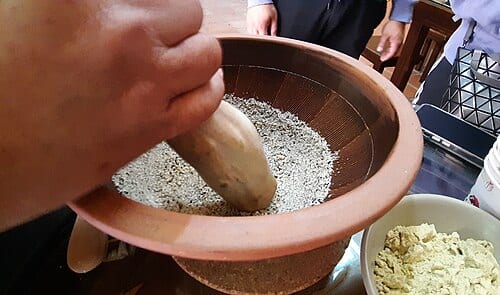
Lei cha is a traditional Hakka ground beverage historically known as san sheng tang, said to descend from a wartime remedy of grinding raw tea, ginger, and rice into a paste to ward off plague. The modern version uses tea leaves, peanuts, sesame, and mixed grains as a base, ground by hand with a wooden pestle in a ceramic mortar. The essence of this drink is not just the drinking but the grinding itself — both Longtan's Sankeng Old Street and the Taiwan Hakka Tea Culture Museum offer hands-on experience spaces where visitors can feel the everyday ritual of Hakka hospitality firsthand.
Lei cha, also known as san sheng tang, is said to originate from a remedy in which raw tea, raw ginger, and raw rice were ground into a paste and drunk to fight off plague among troops; together with Oriental Beauty tea (white-tip oolong) and sour tangerine tea, it forms the Hakka Three Teas.
What is Hakka ground tea
The character "lei" in lei cha means to grind. The traditional tools are a ceramic grinding mortar (lei bo) and a hardwood pestle; the pestle is moved in circles along the mortar wall repeatedly, grinding tea leaves, peanuts, and sesame into fine powder before adding roasted grains (corn, pearl barley, pumpkin seeds, etc.) and continuing to grind. Hot water is poured in and the mixture is stirred with a tea whisk or spoon. The result is a grayish-green, thick paste-like drink; the taste is rich with nut fragrance, clean with tea aroma, and slightly sweet, with considerable filling power. In Hakka tradition, it can serve as a meal substitute — it is not a light beverage.
In Hakka hospitality culture, lei cha holds a role equivalent to gong fu cha in Hokkien culture — when guests arrive, the host grinds lei cha to offer them as an expression of sincerity and respect. The Council for Hakka Affairs lists lei cha as a representative food of Hakka culture, and together with sour tangerine tea and Oriental Beauty oolong tea, it forms the Hakka Three Teas. Several shops on Longtan Sankeng Old Street in Taoyuan offer lei cha experiences, and the Taiwan Hakka Tea Culture Museum runs regular experience sessions, keeping this tradition alive in tangible, participatory form.
How to drink it authentically
Local knowledge
Verified sources
- The Council for Hakka Affairs officially records lei cha as one of the Hakka Three Teas, listed alongside sour tangerine tea and Oriental Beauty oolong tea, with a clearly defined official cultural position.
- The Taiwan Hakka Tea Culture Museum currently runs lei cha experience sessions as a regular offering at an official cultural institution, providing institutional continuity.
- The cultural name for lei cha — "san sheng tang" — appears in the records of the Hakka Homeland Cultural Memory Bank, with historical documentation as a basis.
Visitor tips
- For lei cha experience sessions at the Taiwan Hakka Tea Culture Museum, check opening hours and reservation requirements in advance; session sizes are limited on weekends.
- Lei cha experience shops along Sankeng Old Street each have different pricing structures (some include materials, some charge for the experience only). Confirm the cost before entering to avoid misunderstandings.
- Lei cha contains peanuts. Anyone with a peanut allergy must inform the shop in advance and confirm whether an alternative recipe is available.
Sources: Council for Hakka Affairs official records; Taiwan Hakka Tea Culture Museum experience session materials; Hakka Homeland Cultural Memory Bank.
Frequently Asked Questions
Why is lei cha also called san sheng tang?
Because the traditional recipe grinds three raw ingredients — raw tea, raw ginger, and raw rice — together, giving it the name 'three-raw soup.'
What are the Hakka Three Teas?
The Hakka Three Teas are lei cha, Oriental Beauty tea (white-tip oolong), and sour tangerine tea, officially recognized by the Council for Hakka Affairs.
Where can you grind lei cha yourself?
Several shops on Longtan's Sankeng Old Street and the Taiwan Hakka Tea Culture Museum both offer hands-on grinding experiences.
Sources
- 最具代表客家文化特色的擂茶|國家文化記憶庫 — 文化部國家文化記憶庫,確認三生湯典故
- 食食客客 Foodie In Hakka|客家委員會 — 客家委員會官網,確認客家三大茶名稱