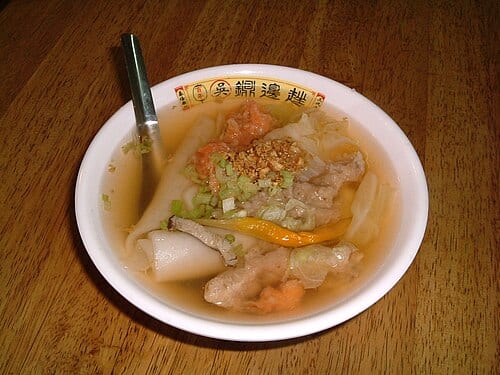
Ding Bian Hu is a traditional Fuzhou rice-milk street snack; the Matsu version is made by pouring rice batter along the rim of a hot wok into thin sheets and scraping them into a seafood broth, giving a soft, thick, drinkable texture. At half past five in the morning at Nangan's Jieshou Market, the stall keeper scoops a ladle of rice milk and pours it along the wok's inner rim: the batter sets instantly into thin sheets and slides into the broth. Finished with dried shrimp, dried flounder, and small dried fish, then scallion and white pepper, this bowl is the morning flavor Matsu people carry down from their Fuzhou ancestors.
Ding Bian Hu originated in Fuzhou, with a legend linking it to Ming-dynasty general Qi Jiguang: as his troops passed southern Fuzhou, locals poured rice batter along the rim of a large pot to form quick sheets for the soldiers. The dish later spread to Taiwan's Minnan region as 'Ding Bian So,' with a thinner broth that needs chewing; Matsu's own version actually has a thicker, more concentrated broth than Keelung's Ding Bian So and can be drunk directly. A-Mei's Ding Bian Hu in Nangan's Jieshou Market has been operating for about 27 years, sells a limited roughly 100 bowls a day starting at 6 a.m. and often selling out before 9, and has been recognized in both the first and third editions of the '500 Bowls' food guide.
What Is Ding Bian Hu
Ding Bian Hu (called "Ding Bian Hu" in Matsu and "Ding Bian So" in Fuzhou) is a traditional rice-based street snack from Eastern Fujian. The method: grind indica rice into a milky batter, then pour it in a thin stream along the inner rim of a large, intensely heated iron wok ("ding"). The batter sets on contact with the heat into thin sheets, which are then scooped down into the soup at the bottom of the wok. The soup base is simmered from pork bones, dried shrimp, dried flounder, small dried fish, and clams, and the toppings include day lily flowers, shiitake mushrooms, shredded pork, shrimp, and celery. The texture falls between flat rice noodles and rice ribbon noodles — soft and tender, with a savory, full-flavored broth.
Matsu's Ding Bian Hu and Keelung's Ding Bian So share the same Fuzhou origin, but the two versions have diverged: the Matsu version stays closer to the Fuzhou original, with a clearer broth and thinner rice sheets, while the Keelung version has undergone Taiwanization and features richer toppings and a thicker soup. The Lienchiang County government lists Ding Bian Hu as a representative Matsu specialty and it is the centerpiece of the archipelago's early-morning market culture. A-Mei Ding Bian Hu in Nangan's Jieshou Market has been operating for more than 20 years and is the stall recognized by both tourists and locals as the benchmark.
How to Eat It Like a Local
Local Know-How
Verified Third-Party Endorsements (Sponsorship Filtered)
- The Lienchiang County Tourism Bureau lists Ding Bian Hu as a representative Matsu specialty, noting its Fuzhou tradition of pouring rice milk along the rim of the wok.
- A-Mei Ding Bian Hu, located in Nangan's Jieshou Market, has been operating for over 20 years and is a well-known local institution.
- Ding Bian Hu and Keelung's Ding Bian So share a common Fuzhou origin and are both representative culinary legacies of Eastern Fujian immigrant communities.
Visiting Tips
- Most Jieshou Market stalls close before noon; arrive before 8 a.m. for the widest selection.
- There are more tourists on weekends and queues form quickly; weekday early mornings are less crowded and feel more authentically local.
- If someone in your group is vegetarian, note that Ding Bian Hu's broth contains meat-based ingredients — inform the stall keeper in advance or order a vegetarian alternative.
Data compiled from the Lienchiang County Tourism Bureau, Matsu Distillery, and a large volume of public reviews; sponsored content has been filtered out.
Frequently Asked Questions
How does Matsu's Ding Bian Hu differ from Keelung's Ding Bian So?
Matsu's version has a thicker broth you can drink directly, while Keelung's is thinner and needs chewing — the opposite of what many assume.
What time does A-Mei's Ding Bian Hu open?
It opens at 6 a.m. daily with a limited supply of about 100 bowls, often selling out before 9 a.m., so arrive early.
Is Ding Bian Hu suitable for vegetarians?
The traditional broth contains dried shrimp and dried flounder, so vegetarians should notify the stall in advance or request an alternative.
Sources
- 鼎邊糊 - 維基百科 — 福州起源、與鼎邊趖差異、馬祖版本口感較濃稠
- 馬祖美食8選!跟著500碗以美食體驗離島的地域風情 — 阿妹的店鼎邊糊獲第一、三屆500碗
- [馬祖早餐推薦] 阿妹的店鼎邊糊 — 營業時間、每日限量約100碗