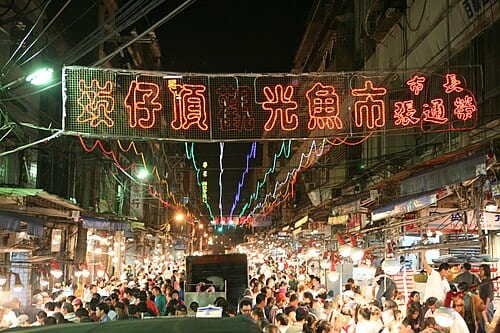
Kanzaiding is a fresh seafood wholesale market on the banks of Xuchuan River in Keelung's Ren'ai District, named after the stone steps ("kan-a" in Taiwanese) that once stood there during the Japanese colonial period. It opens nightly from 1 to 7 a.m., with auctioneers selling entire crates of catch through live bidding to seafood businesses and knowledgeable regulars. All of Keelung is asleep while Kanzaiding is just getting started: the street blazes with light, crates from Nanfang'ao and Badouzi line the pavement, and auctioneers call out prices as buyers nod and bid, closing deals within seconds — one of northern Taiwan's largest fresh seafood wholesale markets.
Fish vendors were already trading along Xuchuan River at Kanzaiding during the Qing dynasty; a 1931 (Showa 6) street directory recorded businesses operating on Xiao-yi Road. In 1978, the Keelung City Government covered over Xuchuan River, turning the former riverbed into today's street. According to the Keelung City Government's tourism website and the National Repository of Cultural Memory, Kanzaiding is now one of northern Taiwan's largest fresh seafood wholesale markets, with roughly 30-plus vendor stalls operating nightly from 1 to 7 a.m.
What is Kanzaiding?
Kanzaiding Fish Market is located in Ren'ai District, Keelung City, above Xuchuan River on Xiao-yi Road, named after the stone steps ("kan-a" in Taiwanese) that once stood there during the Japanese colonial era. It is not a tourist market — it is one of the most important fresh seafood wholesale markets in northern Taiwan, open every night from 1 a.m. to 7 a.m. Auctioneers sell entire crates of catch to seafood businesses, restaurant buyers, and knowledgeable foodies through a live bidding system called "fish-calling." Stalls line up along a hundred-meter stretch of street, offering everything from live octopus, mi-fish, and mullet to deep-sea shrimp, crab, and shellfish. Inventory moves extremely fast — "everything gone within half an hour of arrival" is the norm.
Why Keelung? Keelung was Taiwan's most important international port from the Japanese colonial period through the early post-war era. The surrounding fishing ports of Badouzi, Zhengbin, and Waimushan are adjacent, making it the natural collection point for northeast Taiwan's catch. Fish vendors at Kanzaiding were trading along Xuchuan River as far back as the Qing dynasty; the market consolidated into a regular night-market format during the Japanese colonial period and has continued unbroken for over a century. Both the Keelung City Government and the Tourism Administration officially identify Kanzaiding as one of northern Taiwan's largest fresh seafood wholesale markets. It is now open to the general public to observe at night, but visitors must follow the rules: don't block the aisles, don't use flash photography, don't haggle with the auctioneers.
How to experience it like a local
Local knowledge
Verified references (no sponsored content)
- The Tourism Administration and Keelung City Government both list Kanzaiding as one of northern Taiwan's largest fresh seafood wholesale markets.
- The market's history traces back to the Qing dynasty; it consolidated into a regular night-market format during the Japanese colonial period and continues to this day.
- Daily transaction volume is in the hundreds of millions, sustaining the supply chain for restaurants and seafood businesses throughout northern Taiwan.
Practical tips
- The market is typically closed on Mondays and open Tuesday through Sunday in the early morning hours — check the schedule for that week before heading out.
- The floor is wet and greasy — wear closed shoes, not sandals or flip-flops. Your clothes will smell of fish on the way home.
- Never interrupt an auctioneer mid-call. Stay to the side and keep quiet while observing.
Information compiled from the Keelung City Government Department of Tourism and City Marketing and large-volume public reviews, with sponsored content filtered out.
Frequently Asked Questions
Where does the name Kanzaiding come from?
"Kan-a" is Taiwanese for "stone steps," named after the steps local fishermen once climbed to carry their catch up to street level during the Japanese colonial period.
What hours is Kanzaiding open?
It operates nightly from 1 a.m. to 7 a.m., with trading peaking between roughly 2 and 4 a.m.
Is Kanzaiding a tourist market?
No, it is one of northern Taiwan's largest fresh seafood wholesale markets, primarily serving seafood businesses and restaurant buyers; the public can observe at night but must follow rules like not blocking aisles or using flash photography.
Sources
- 崁仔頂魚市|國家文化記憶庫 — 官方文化記憶庫記載1931年商店名冊與1978年河道加蓋
- 崁仔頂漁市 - 基隆市政府觀光網 — 官方觀光網站確認營業時間01:00-07:00與市場規模