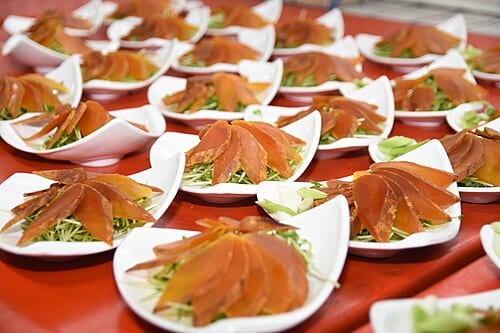
Dried mullet roe is a traditional Taiwanese seafood product made by salt-curing and wind-drying gray mullet ovaries — known locally as wuyuzi — with the coastal areas of Budai and Dongshi in Chiayi County among its main production regions. Gray mullet migrate into Taiwan's coastal waters from November through January, with peak catches occurring roughly ten days around the winter solstice; fishermen harvest and process the roe fresh, and Budai's processing plants typically sell direct, at prices slightly below the more famous Tainan Beimen product.
Wild gray mullet migrate into southwestern Taiwan's coastal waters to spawn from November through late January, with the peak fishing period falling roughly ten days around the winter solstice (per UDN and Ministry of Agriculture reporting). The coastal Budai and Dongshi areas of Chiayi County are an important production region for both wild and farmed mullet, with several processing plants in Budai offering direct sales of freshly harvested roe around the winter solstice.
What is dried mullet roe
Gray mullet (Mugil cephalus) ovaries are salt-cured, pressed into shape, then sun-dried or cold-air-dried for several days, forming flat orange-yellow mullet roe blocks. Quality indicators: thickness of about 1 to 1.5 cm, evenly orange-yellow color, and a fine cross-section with no air pockets. An overly fishy smell or dark coloring indicates poor processing. The most traditional way to eat it is to lightly grill it, slice it thin, and layer each piece with a slice of white radish or garlic shoot before eating — the crisp vegetables cut through the saltiness and bring out the sweetness.
The coastal area of Budai and Dongshi in Chiayi County is one of Taiwan's important mullet roe production areas. Every year from November to January, gray mullet enter the harbor; ovaries are harvested fresh and processed on the spot. Processing plants can often sell directly to consumers, cutting out intermediate distribution costs. Budai Harbor mullet roe is primarily processed locally, priced slightly lower than the more famous Tainan Beimen product — though quality differences depend on the processing method. Tasting a slice before buying is recommended.
How to eat it the local way
Local knowledge
Verified background
- The coastal area of Budai and Dongshi, Chiayi County, is one of Taiwan's key mullet roe production areas, with gray mullet entering the harbor around the winter solstice each year (November–January).
- Budai Harbor processing plants offer direct sales, eliminating intermediate distribution costs and pricing slightly below the more prominent Tainan Beimen production area.
- Grilling and pairing with white radish slices is the most traditional eating method, a practice shared across Taiwan's coastal fishing villages.
Practical notes
- Seasonal product — outside the November–January season, confirm whether items are cold-storage stock, as storage conditions have a significant impact on quality.
- Budai processing plants do not operate in a tourism mode. Calling ahead to arrange a visit and purchase is recommended rather than showing up unannounced.
- Always taste a cut slice before buying. Smell, color, and thickness are three quick indicators of processing quality — do not rely solely on packaging labels.
Sources: Budai Harbor fishery status, Chiayi County coastal mullet roe processing survey.
Frequently Asked Questions
When is mullet roe season?
From November through January, with the peak catch around ten days before and after the winter solstice.
How does Budai roe compare to Tainan's Beimen roe?
Budai's processing plants mostly sell direct, priced slightly below the better-known Beimen product, though quality depends on processing method.
What's the traditional way to eat it?
The traditional method is to grill it, slice it thin, and eat it layered with white radish slices, which cut the saltiness and bring out its sweetness.
Sources
- 影/整車傾洩而下烏魚瀑布壯觀!嘉縣烏魚子產季登場…開盤價曝 — 烏魚洄游季節11-1月、冬至前後盛漁期
- 臺灣烏金(農業部全球資訊網) — 農業部烏魚產業資料