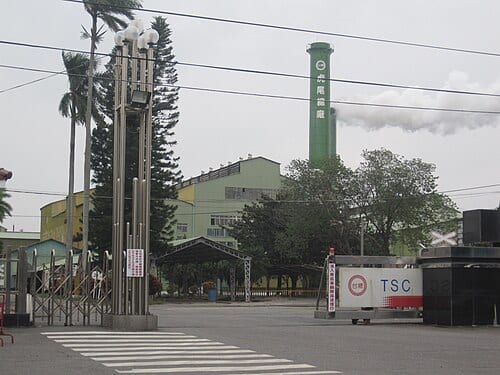
Huwei Sugar Factory Creative Park is a heritage tourism park in Huwei Township, Yunlin, converted from a Japanese-era sugar mill. The original Huwei Sugar Factory was established by Dai-Nippon Sugar Manufacturing Co., and its first factory was completed in 1909; by 1924 its daily crushing capacity reached 3,200 British tons, the highest among Taiwan's 49 modern sugar mills of the era, earning it the nickname "Number One in the East." Taiwan's sugar industry served as a primary source of foreign exchange from the 1950s through the 70s, and Huwei Sugar Factory was the industrial core of Yunlin County during that era. Today the grounds preserve the sugar railway tracks, narrow-gauge locomotives, and red-brick factory buildings — an important site for experiencing Taiwan's sugar industry history.
According to Taiwan Sugar Corporation and Wikipedia, Huwei Sugar Factory was built by Dai-Nippon Sugar Manufacturing Co., which obtained its establishment license in 1906 and completed the first factory in 1909. By 1924, the first factory's crushing capacity had expanded to 3,200 British tons per day, surpassing Taiwan Sugar Manufacturing Co.'s Akou factory and making it the highest-output mill among Taiwan's 49 modern sugar factories at the time — earning it the nickname "Number One in the East." From 1925, it also used molasses, a byproduct of sugar refining, to produce alcohol, becoming one of the largest alcohol plants in East Asia.
Highlights of Huwei Sugar Factory Creative Park
The park displays several 762-mm narrow-gauge steam and diesel locomotives — physical artifacts of Taiwan's sugar railway ("sugar rail") system. The red-brick factory buildings retain the architectural style of the late Japanese colonial period through the early postwar years, and some have been converted into exhibition and event spaces. Sections of the old sugar rail tracks are still visible within the factory grounds, evoking the era when small trains linked the cane fields to the mill.
The Taiwan Sugar direct retail outlet sells traditional frozen treats made with Taiwan Sugar cane sugar — the most popular consumer experience at the factory, with noticeably long queues in summer. The park holds an annual sugar factory cultural festival with performances and market activities. For event dates, check official information from Huwei Sugar Factory or Taiwan Sugar Corporation.
How to make the most of your visit
Practical information
Getting there and hours
- The park is open year-round, but individual exhibition spaces and the Taiwan Sugar ice cream stall have their own hours. Check Taiwan Sugar Corporation's Huwei Factory official information before visiting.
- By car, take Provincial Highway 19 or a county road into Huwei Township. The sugar factory is on Minzhu 3rd Road. There is a car park on the grounds, but spaces are limited on busy weekends.
- City buses serve Huwei town; from the stop, walk or rent a Youbike to reach the factory. It is about one to two kilometers from Huwei Joint Government Hall and the Puppetry Museum.
Nearby connections
- Huwei one-day cultural route: Sugar Factory → Huwei Iron Bridge (for sunset) → Joint Government Hall → Glove Puppetry Museum. The whole circuit can be done on foot plus short cycling stretches — no car rental needed.
- Xiluo Bridge is about fifteen kilometers south; Douliu City is about fifteen kilometers east. Huwei is the geographic hub for a central Yunlin itinerary.
Sources: Taiwan Sugar Corporation, Yunlin County Government Tourism Information.
Frequently Asked Questions
Why was Huwei Sugar Factory called "Number One in the East"?
Because by 1924 its first factory's crushing capacity had grown to 3,200 British tons per day, the highest output among Taiwan's 49 modern sugar mills at the time.
When was Huwei Sugar Factory built?
Dai-Nippon Sugar Manufacturing Co. obtained its establishment license in 1906 and completed the first factory in 1909.
Is Huwei Sugar Factory still producing sugar today?
No, it now operates as a heritage tourism park preserving the sugar railway tracks, narrow-gauge locomotives, and red-brick buildings rather than as an active sugar mill.
Sources
- 虎尾糖廠 - 台灣糖業股份有限公司 — 官方沿革資訊
- 台糖虎尾總廠 - 維基百科 — 建廠年份與東洋第一產量數據