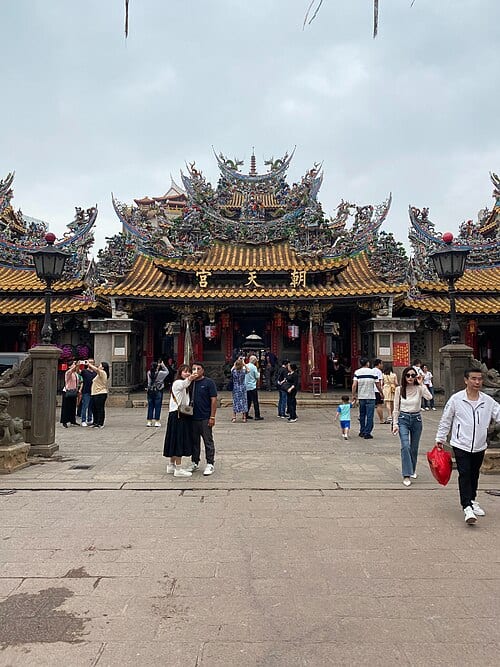
Beigang Chaotian Temple is one of the oldest and most visited Mazu temples in Taiwan, founded in 1694 (the 33rd year of the Kangxi reign) when Linji-sect monk Shubi brought a Mazu statue from Meizhou, Fujian, to establish the temple; it is now a national monument. Over three hundred years, it has drawn countless pilgrims, and successive rounds of community-funded restoration have turned the complex into a showcase of craftsmanship — visitors who step through the gate encounter masterful stone carving, wood carving, and painted decoration alongside the incense smoke.
Beigang Chaotian Temple was founded in 1694 (the 33rd year of the Kangxi reign), when the 34th-generation Linji-sect monk Shubi brought a Mazu statue from Meizhou's Chaotian Pavilion in Fujian to Beigang (then Ponkan) to establish the temple; it was listed as a second-grade monument in 1985 and reclassified as a national monument in 1997 (National Cultural Heritage Database). Major renovations took place in 1775, 1837, and 1855, giving the temple its current four-hall, deep-set layout.
Highlights of Beigang Chaotian Temple
The temple architecture blends Minnan and Chaozhou craft traditions. The stone carvings on the dragon-and-tiger walls of the main front hall are the finest details: intricate cuts, dense compositions, and three-dimensional dragon scales, cloud patterns, and narrative figures. The painted murals in the main hall were completed by successive master painters across generations and remain well preserved. The entire temple is a national monument, and the Ministry of Culture applies strict restoration review to the structure, so what visitors see is a living historical site in ongoing conservation.
The Beigang Mazu Procession held around the Lantern Festival each lunar year is the largest folk religious event in Yunlin. Troupe performances, lantern floats, and firecracker towers fill the town's main streets through the night, drawing tens of thousands of devotees. The dates follow the lunar calendar; check for the exact date each year in advance. The traditional snacks near the temple gate — duck broth thickener soup, mallow soup, and fried tofu — are an extension of local food culture.
How to make the most of your visit
Practical information
Getting there and hours
- The temple is open year-round; general visiting hours are roughly 5 a.m. to late night. During the Lantern Festival procession the temple stays open through the night — check on-site notices for current hours.
- By car, park at the Beigang Farmers' Association lot or paid car parks near the temple. By bus, take Taiwan Bus or Unibus to Beigang Transfer Station; the temple is about a five-minute walk.
- Roads are closed during the procession. Public transport is recommended; plan ahead if driving as parking is difficult.
Nearby connections
- Across Beigang Creek lies Xingang Township in Chiayi County. You can extend the trip to Xingang Fengtian Temple and the Bantou Village jiaozhi pottery community, linking a Yunlin–Chiayi Mazu pilgrimage cultural route.
- Within Beigang town, Wude Hall (a Japanese-era martial arts hall) and Beigang Arts Center are also historic buildings reachable on foot.
Sources: Cultural Heritage Bureau (Ministry of Culture) Monument Database, Yunlin County Government Tourism Information.
Frequently Asked Questions
When was Beigang Chaotian Temple founded?
It was founded in 1694, the 33rd year of the Kangxi reign.
What heritage status does the temple hold?
It was listed as a second-grade monument in 1985 and reclassified as a national monument in 1997.
When is the Beigang Mazu procession held?
Usually around the Lantern Festival in the lunar calendar; the exact date varies each year.
Sources
- 國定古蹟-北港朝天宮 — 國家文化資產網,古蹟等級沿革
- 大事年表-北港朝天宮 — 北港朝天宮官網,創建與歷代修建年表