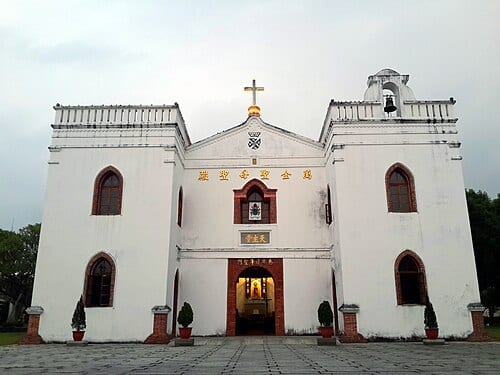
Wanjin Catholic Church (the Basilica of the Immaculate Conception) is Taiwan's oldest surviving Catholic church building; the current church was inaugurated on December 8, 1870 (Tongzhi 9), and in 1984 Pope John Paul II elevated it to the status of minor basilica — the first in Taiwan. The church follows a basilica-style design and is dedicated to the Virgin Mary as its patron saint.
The Wanjin parish traces back to 1861, when Spanish Dominican priest Fernando Sainz began missionary work in the area; a first church was built in 1863 but was damaged by an earthquake and arson in 1866. Father Sainz then acquired surrounding land and rebuilt the church, which was inaugurated on December 8, 1870 (Tongzhi 9) — the building that stands today. In 1984, Pope John Paul II elevated it to the status of minor basilica, the first in Taiwan.
Highlights of Wanjin Catholic Church
Wanjin Catholic Church was established by Spanish Dominican missionary Fernando Sainz when he began his mission in 1861; the main structure of the existing church was completed in 1863 and has since undergone several restorations. In 1874 the Qing court imperially awarded the church a plaque bearing the words "Feng Zhi" (Imperial Decree), making it one of the few Catholic churches to receive formal recognition from the Qing court — a distinction of special historical significance. The church is built of limestone, with three circular arched doorways on the main facade and bell towers on each side. The interior preserves Qing-dynasty painted religious icons and a European-style wooden altar, and is an important physical record for the study of the history of Catholic missionary work in Taiwan.
Wanjin Village is a traditional settlement of the Makatao Pingpu people and is one of the indigenous communities in Taiwan that accepted Catholic faith relatively early, resulting in a distinctive form of belief that blends Catholicism with local culture. The surrounding community preserves traditional Catholic festival customs; the midnight Mass on Christmas Eve draws worshippers from across the country. During the Christmas season (approximately early December to New Year's Day), the large-scale light installations outside the church are spectacular and draw the densest crowds. Visiting on a regular weekday allows visitors to experience the historic atmosphere of the century-old church in peace.
How to make the most of your visit
Practical information
Getting there and timing
- Wanjin Village is located in Wanluan Township; driving from Pingtung City takes approximately 30 to 40 minutes. There is no convenient direct public transport; renting a car or self-driving is recommended.
- The church is open year-round with no entry fee. General visiting hours run from morning to late afternoon; visits during Mass times are not recommended. You can check the Pingtung County Government tourism information for confirmed opening hours before your visit.
- Visitor numbers surge during the Christmas season (December), making parking difficult. Visiting on a weekday daytime is recommended to focus on the architecture itself.
Nearby connections
- Wanluan Township is famous for Wanluan pork knuckle; the pork knuckle restaurants along Wanluan Old Street near Wanjin Village are a dining option after your visit. Wanluan pork knuckle is typically braised until tender.
- Sandimen Indigenous Cultural Museum is about 25 km from Wanjin Village and can be combined into a half-day indigenous culture-themed itinerary.
Sources: Bureau of Cultural Heritage, Ministry of Culture (third-grade historic site records); Wanluan Township Office, Pingtung County.
Frequently Asked Questions
Why is Wanjin Catholic Church called a basilica?
In 1984, Pope John Paul II elevated it to the status of minor basilica, the first Catholic church in Taiwan to receive this honor.
When was the current Wanjin Catholic Church built?
The current building was inaugurated on December 8, 1870 (Tongzhi 9), making it Taiwan's oldest surviving Catholic church building.
Who founded Wanjin Catholic Church?
Spanish Dominican priest Fernando Sainz began missionary work here in 1861 and built the first church in 1863; after 1866 damage, its rebuilding led to the current building.
Sources
- 萬金聖母聖殿 - 維基百科 — 建堂年份、聖殿敕封年份
- 郭德剛 - 維基百科 — 郭德剛神父本名Fernando Sainz及傳教沿革