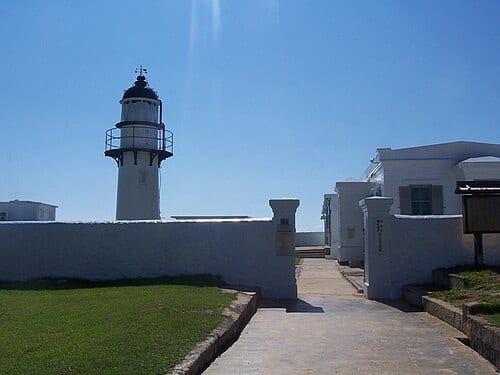
Yuwengdao Lighthouse is one of the earliest lighthouses still standing in Taiwan, first built in 1778 by Taiwan Prefecture magistrate Jiang Yuanshu; the current white circular iron tower was rebuilt in 1875 by British engineers hired through the customs service and is now a National Historic Site. Located at the westernmost tip of Xiyu Island, its light has reached a range of 25.1 nautical miles since a 1966 lamp upgrade and it remains an active navigation aid today.
Yuwengdao Lighthouse was first built in the 43rd year of the Qianlong reign (1778) as a seven-tier stone tower, the first lighthouse established in the Taiwan-Penghu region. Between 1874 and 1875 the Imperial Maritime Customs Service, under British engineer D. M. Henderson, rebuilt it as a round iron tower about 2.5 meters in base diameter, initially reaching 15 nautical miles. In 1966 a new fourth-order rotating lens lamp of 800,000 candlepower extended the range to 25.1 nautical miles. It was designated a National Historic Site in 1987 and is now managed by the Maritime and Port Bureau.
Highlights of Yuwengdao Lighthouse
The lighthouse's earliest construction in the Qianlong era reflects Penghu's role as an important shipping transit point during the Qing Dynasty; merchant and fishing vessels passing through the Taiwan Strait relied on it for orientation. The current main tower, rebuilt in 1875, is a white circular brick structure — taller than the earlier stone lighthouse — and a range of 20 nautical miles confirms it still serves an active navigation function.
The lighthouse stands on cliffside terrain at the westernmost tip of Xiyu Island, facing west across the Taiwan Strait. On clear days you can look out over a vast expanse of open water. The white lighthouse tower stands out sharply against a blue sky. The surrounding compound has preserved the ancillary buildings used to manage the lighthouse, and the whole site is well maintained.
Tips for Getting the Most Out of Your Visit
Practical Information
Getting There & Time
- Located in Waian Village, Xiyu Township, close to Xiyu West Fort. From Magong City, cross the Penghu Great Bridge and continue south — about 50–60 minutes by scooter.
- Check opening hours before you go with the Maritime and Port Bureau, Ministry of Transportation and Communications, or on-site notices; access may be restricted during certain hours.
- Combine with Xiyu West Fort for a total of about 2–2.5 hours.
Nearby Connections
- Directly adjacent to Xiyu West Fort — a few minutes on foot or by scooter makes them the core heritage pairing at Waian Village.
- Xiyu Township also has Daguoye Basalt Columns (Chidong Village) and Erkan Village — plan a full-day Xiyu itinerary.
Sources: Cultural Heritage Bureau, Ministry of Culture (National Historic Site records).
Frequently Asked Questions
When was Yuwengdao Lighthouse first built?
It was first built in 1778, making it one of the earliest lighthouses established in the Taiwan-Penghu region.
Is the current white tower the original lighthouse?
No, the current white circular iron tower was rebuilt in 1875 by British engineers hired by the customs service.
How far does Yuwengdao Lighthouse's light reach today?
After a 1966 lamp upgrade, its range extended to 25.1 nautical miles, and it remains in active operation.
Sources
- 漁翁島燈塔 - 維基百科 — 創建、改建與光程沿革