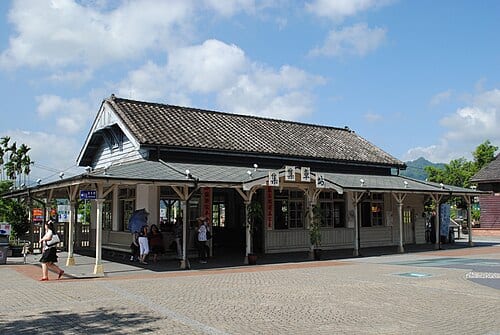
Jiji Train Station is the central station of the Jiji Branch Line in Nantou County's Jiji Township, first established in 1922; its surviving wooden building, relocated from the old Yangmei Station on the Western Line, was completed in 1930 and preserves the cypress-wood station style of the Japanese colonial era. The building tilted severely in the 1999 921 Earthquake and was restored to its original form, reopening in February 2001. It is now the primary destination on the Jiji Branch Line tourist railway.
Jiji Station (originally Jiji Eki) was established on January 15, 1922. The surviving wooden station building, relocated from the old Yangmei Station on the Western Line, was completed on February 2, 1930. The 1999 921 Earthquake left the structure severely tilted; it was rebuilt using original construction methods and reopened on February 7, 2001, with the full Jiji Branch Line restored to service on January 21, 2001.
Highlights of Jiji Train Station
The Jiji Station building is a Japanese-style wooden structure with a traditional pitched roof and exposed structural elements under the eaves; the wooden joinery is partly visible from the exterior. The ticket window and waiting benches inside the station retain a traditional style, and the overall spatial scale is modest but well-proportioned. The post-921 reconstruction project followed the principle of maintaining the original appearance as closely as possible, and the reconstruction process itself has become part of the local history. A retired steam locomotive is displayed on the platform beside the station for photography and viewing — the focal point of the platform area.
Jiji Township is known for its bananas and green tunnel. The main roads through town are lined with camphor trees that form shaded corridors in summer. Walking from Jiji Train Station, you can reach Jiji Wuchang Temple (the temple's main structure tilted but did not collapse in the 921 Earthquake and has been preserved as an earthquake memorial site), the Jiji Diversion Weir Exhibition Hall, and other attractions — forming a walking tour of the small town that can be completed on foot. The Jiji Branch Line stops include Shuili and Checheng, making it possible to plan a full-day railway itinerary connecting all three.
Tips for Making the Most of Your Visit
Practical Information
Getting There & Time Required
- Take the TRA to Ershui Station, then transfer to the Jiji Branch Line to Jiji Station. Trains run approximately every 1 to 2 hours; the journey takes about 30 to 40 minutes. Additional departures are added on weekends — check the TRA timetable.
- The walkable attractions in Jiji Township can be covered in half a day; extending the trip to the Checheng terminus warrants a full day.
Nearby Connections
- The Jiji Branch Line connects Shuili and Checheng (Shuili Snake Kiln, Checheng wooden station), combining all three into a complete Jiji Branch Line railway itinerary.
- Heading north leads to Zhushan and Zinan Temple; heading east leads to Sun Moon Lake. Jiji's geographic location in south-central Nantou County gives it excellent connecting potential.
Sources: Taiwan Railways Administration Jiji Branch Line materials, Jiji Township Office tourism information.
Frequently Asked Questions
When was Jiji Train Station built?
Jiji Station was first established in 1922, and its surviving wooden building — relocated from the old Yangmei Station — was completed in 1930.
How did the 921 Earthquake affect Jiji Train Station?
The 1999 921 Earthquake left the building severely tilted; it was rebuilt using the original construction techniques and reopened in February 2001.
What can be combined with a visit to Jiji Train Station?
The Jiji Branch Line connects to Shuili and Checheng for a full railway day trip, and Wuchang Temple's earthquake memorial site is within walking distance.
Sources
- 集集車站 - 維基百科 — 設站、木造站房完工與921地震重建年份