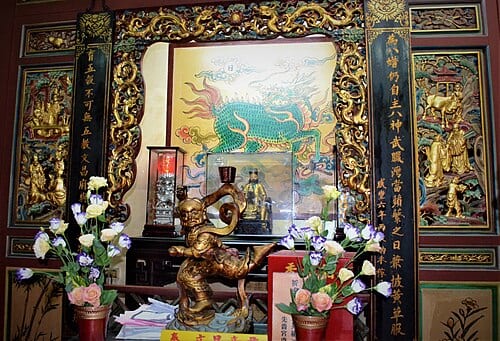
Sanchong Xianse Temple is a temple dedicated to Shennong Dadi, the Divine Farmer, founded in the 20th year of the Qianlong reign (1755). Originally known as "Wugu Xiandi Temple," it is one of the most representative centers of worship in Sanchong District. The temple has been relocated and rebuilt several times, and its present appearance dates to a 1925 reconstruction during the Japanese colonial era (Taisho 14); the current structure is a five-story building of considerable scale. The annual birthday celebration for Shennong Dadi (the 26th day of the 4th lunar month) draws a large number of worshippers from across the region.
Xianse Temple was founded in 1755 (Qianlong 20) under the original name "Wugu Xiandi Temple," first built at Toucian Village in Xinzhuang before flooding forced its relocation to the current site. In 1850 (Daoguang 30), local gentry leader Lin Maosheng led a reconstruction that expanded it into a front-and-rear hall layout. The temple's present appearance dates to a 1925 (Taisho 14) reconstruction organized by Lin Qingdun during the Japanese colonial era.
What to see at Sanchong Xianse Temple
Xianse Temple was founded over 270 years ago and is one of the oldest temples in Sanchong, predating the district's transformation from an agricultural settlement into an industrial hub and eventually into the modern urban district it is today. The term "Xianse" derives from an ancient honorific for the deity of agriculture. Shennong Dadi governs farming and medicine, and the cult was closely tied to the agricultural lives of early Han Chinese settlers. The temple has been rebuilt and expanded multiple times; the current structure takes the form of a modern temple building.
The existing temple is a five-story building with different deities enshrined on each floor. The main hall is spacious and well attended. The painted murals and intricate jiǎnniè (ceramic mosaic) decorations throughout are fine examples of the craft; the carved deity figures on each floor and the decorative craftsmanship are worth examining closely. The Shennong Dadi birthday celebration on the 26th day of the 4th lunar month is the year's grandest event, drawing worshippers from across greater Taipei; the plaza in front of the temple is exceptionally lively. If the timing works, a visit during the festival is a vivid experience of traditional Taiwanese temple culture.
How to make the most of your visit
Practical Information
Getting There and Time
- From Sanchong Station on the MRT Zhonghe-Xinlu Line, it is approximately a 10-to-15-minute walk; buses to stops near Zhengyi South Road are also available.
- The temple is open year-round, with worshippers present from early morning to late evening every day. Crowds are heaviest on the 1st and 15th days of the lunar month and during festivals.
Nearby Connections
- Sanchong District is adjacent to Luzhou; combining a visit with the Luzhou Li Family Ancestral Mansion makes a good one-day humanities itinerary for the western part of New Taipei.
- Heading toward Banqiao connects you to the Lin Family Mansion and Garden for a Qing-dynasty architecture themed itinerary; heading toward Taipei provides quick access to Dadaocheng.
Sources: Sanchong Xianse Temple public information, Sanchong District religious and cultural data from New Taipei City.
Frequently Asked Questions
When was Sanchong Xianse Temple founded?
It was founded in 1755 (Qianlong 20), not 1752 as sometimes cited, and was originally named "Wugu Xiandi Temple."
When does the temple's current appearance date from?
The present structure dates to a 1925 (Taisho 14) reconstruction led by local figure Lin Qingdun during the Japanese colonial era.
Which deity is enshrined at Xianse Temple?
The primary deity is Shennong Dadi, the Divine Farmer; "Xianse" is an ancient honorific title for this agricultural deity.
Sources
- 三重先嗇宮 - 臺灣宗教文化地圖 — 創建1755年、原名五穀先帝廟
- 先嗇宮-廟宇篇 - 新北市三重區公所 — 官方沿革、1925年重建