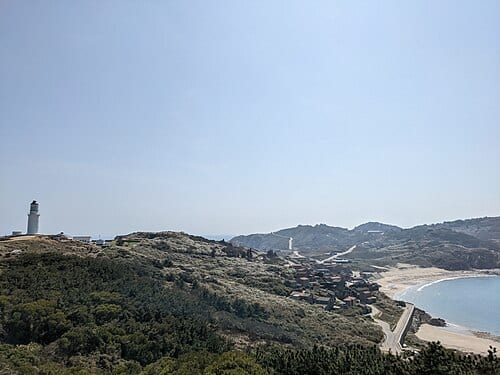
Fuzheng Village is a Minyue fishing settlement on a bay on the southern side of Dongju Island in Matsu. Once Dongju's most populous and prosperous fishing village with nearly a hundred households at its peak, it now has only about ten remaining residents, its stone houses lining the curve of the bay as witnesses to the rise and fall of the local fishing industry.
Fuzheng Village was settled by Minyue immigrants during the Qing dynasty, drawn by the rich yellow croaker and other fishing grounds near Matsu; at its peak the village had nearly a hundred households. Fish stocks declined sharply in the 1960s–70s, and after wartime administration controls on population movement were lifted, young residents moved to Taiwan in large numbers, leaving only about ten households today. A local saying, "summer in Fuzheng, winter in Dapu," reflects the islanders' seasonal wisdom in choosing where to live according to the monsoon.
Highlights of Fuzheng Village
Fuzheng Village prospered thanks to the rich hairtail fish stocks of the Matsu fishing grounds; at its peak, boats came and went constantly and the population numbered in the hundreds. The decline in fish stocks during the 1960s and 70s, combined with restrictions on movement during the wartime administration period, limited population flow. After martial law was lifted, young residents moved to Taiwan in large numbers and the settlement emptied rapidly. Most surviving stone houses follow the "two-slope" (gabled) roof form, with walls stacked from granite blocks in a simple, durable method.
The settlement curves along the bay; viewed from the bay entrance, the old houses step back up the hillside in a layered, pictorial composition. Some structures have been restored as guesthouses, giving visitors the option to spend a night on Dongju. At low tide, the sandy beach in front of the settlement is exposed, forming — together with the stone houses, hillside, and deep blue water — one of Juguang Township's most representative village landscapes.
How to Make the Most of Your Visit
Practical Information
Getting There and Time Needed
- To reach Dongju, take a ferry from Fuao Harbor on Nangan, approximately 1 to 1.5 hours. Schedules are affected by weather — confirm with Matsu Shipping Company before departure.
- Fuzheng Village is about a 15- to 20-minute walk from Dongju's pier (Meng'ao Harbor), or ask locally about scooter rental.
Nearby Connections
- Can be combined with Dongju Lighthouse (about 20 to 30 minutes on foot) and Dapu Rock Inscription for a Dongju day hike — the three sites are all connected by trails.
- Kunqiu Beach (Square Waves) and Caipu'ao Geopark on West Juguang can be visited on a separate day by ferry; there are boats between East and West Juguang.
Source: Lienchiang County Government, Matsu National Scenic Area Administration official website.
Frequently Asked Questions
How many people once lived in Fuzheng Village?
At its peak, Fuzheng Village had nearly a hundred households and was Dongju's most populous fishing village; today only about ten households remain.
Why did Fuzheng Village decline?
Fishing stocks fell sharply in the 1960s and 70s, and after wartime administrative controls were lifted, young residents moved to Taiwan in large numbers, rapidly emptying the settlement.
What does the saying "summer in Fuzheng, winter in Dapu" mean?
It reflects a seasonal pattern on Dongju: Fuzheng is more comfortable in summer, while Dapu offers better shelter from winter winds.
Sources
- 福正聚落-馬祖國家風景區觀光資訊網 — 官方景點介紹,確認聚落現況
- 【馬祖東莒】北福正南大埔 — 確認人口全盛近百戶、現存約十戶及「夏福正冬大浦」諺語