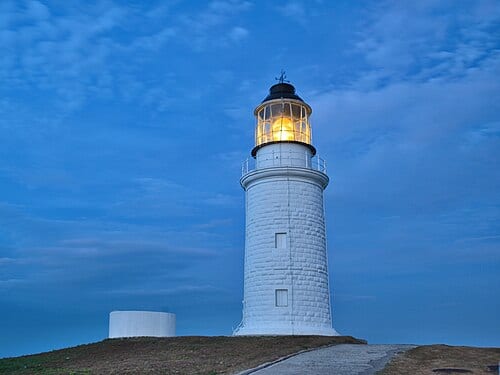
Dongju Lighthouse (Dongquan Lighthouse) is a national historic site lighthouse on Dongju Island in Matsu. Completed in 1872 and built of local granite, it was the first Western-style lighthouse in the Taiwan-Fujian region constructed of granite, stands 19.5 meters tall, and was first lit on July 12, 1872. Its "one long, two short" flash pattern still guides passing ships today.
Dongju Lighthouse was completed in 1872 (Qing Tongzhi 11th year) and first lit on July 12 of that year. It stands 19.5 meters tall and was the first Western-style lighthouse in the Taiwan-Fujian region built of granite. Designated a class-two historic site in 1988, it is now a national historic site and one of Taiwan's national historic sites located farthest from the main island.
Highlights of Dongju Lighthouse
In the mid-nineteenth century, British vessels traded frequently along East China Sea routes. To ensure safe navigation off the Fujian and Zhejiang coasts, Britain negotiated with the Qing court to establish lighthouses in the Matsu sea area. Dongquan Lighthouse (Dongju was formerly known as "Dongquan") was completed in 1872. Its cylindrical tower, built from locally quarried granite, has walls over one meter thick. The light reaches 31 kilometers; on clear days, ships off Taiwan's western coast can see its beam.
The lighthouse complex includes the main tower, the lightkeeper's quarters (now restored and open to visitors), and auxiliary buildings such as an oil storage room — the overall layout is intact, a testament to late-Qing Sino-British cooperative construction. The open grounds around the lighthouse offer no shelter from the wind, and visitors often sit on the grass, looking down at the reefs and surging waves below the cliffs. At night, the light flashes in its regular pattern — Dongju Island's most recognizable nocturnal sight.
How to Make the Most of Your Visit
Practical Information
Getting There and Time Needed
- To reach Dongju, take a ferry from Fuao Harbor on Nangan, approximately 1 to 1.5 hours. There are also boats between the Juguang islands (East and West Juguang). Schedules are closely tied to weather — check the latest timetable with Matsu Shipping Company.
- Dongju Island is small. The lighthouse is about a 20- to 30-minute walk from Fuzheng Village, or you can rent a scooter on the island.
- The lighthouse area has interpretive signs. Visit during daylight to observe the architectural details.
Nearby Connections
- On Dongju Island, combine with Fuzheng Village and Dapu Rock Inscription for a full day. Recommended route: start from the lighthouse and walk the trail down to Fuzheng.
- If you have two days, take a boat to West Juguang to visit Square Waves (Kunqiu Beach) and Caipu'ao Geopark.
Source: Ministry of Culture Bureau of Cultural Heritage national historic site records, Matsu National Scenic Area Administration.
Frequently Asked Questions
When was Dongju Lighthouse built?
Dongju Lighthouse (Dongquan Lighthouse) was completed in 1872 and first lit on July 12 of that year.
Why was it built with granite?
It was built with locally quarried granite from Dongju Island, making it the first Western-style lighthouse in the Taiwan-Fujian region constructed of granite.
How tall is Dongju Lighthouse?
The lighthouse stands 19.5 meters tall and is one of the best-preserved Western-style lighthouses in Matsu.
Sources
- 國定古蹟環景導覽-東犬燈塔 — 文化部文化資產局,確認建造年份、高度、花崗岩材質
- 東莒島燈塔-維基百科 — 確認1988年古蹟指定與首次點燈日期