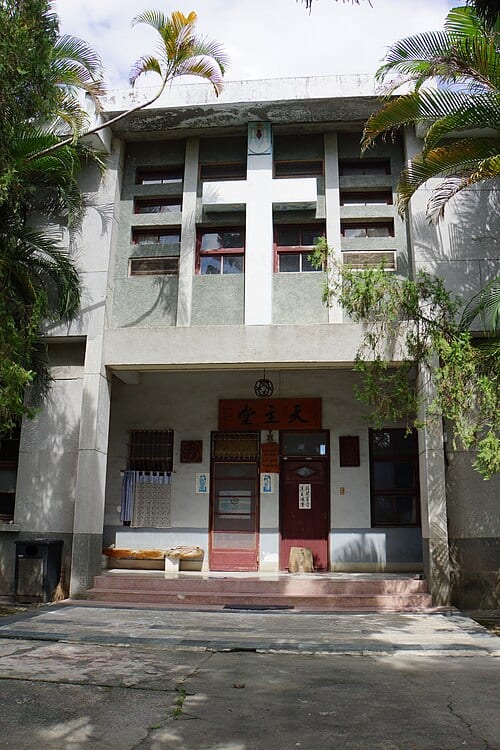
Xincheng Catholic Church is a Catholic church built on the former site of the Xincheng Shrine in Xincheng Township, Hualien County; its main "Noah's Ark" chapel, built by the Diocese of Hualien after it purchased the land, was completed in 1966. The site is tied to the 1896 Xincheng Incident, in which Japanese soldiers assaulted a Truku woman, triggering a Truku attack on the garrison — Japanese authorities later built a Shinto shrine on the site, which became a Catholic church after the war.
The site of Xincheng Catholic Church was originally home to the Japanese-era Xincheng Shrine, rebuilt in reinforced concrete in 1937 (Showa 12), per the Hualien County Cultural Affairs Bureau. Its history traces back to the 1896 Xincheng Incident, in which Japanese soldiers assaulted a Truku woman, provoking a Truku attack on the garrison; Japanese authorities later built a wooden ossuary in 1914 and a monument to fallen soldiers in 1920, before completing the shrine itself in 1937. Starting in 1956, Swiss missionary priests built a kindergarten and residence on the site's west side; the Diocese of Hualien purchased the land in 1964, and the "Noah's Ark"-shaped chapel that forms today's church was completed in 1966. Note: the site is not linked to the 1878 Jialiwan Incident, and the commonly repeated claim that the church was "built in 1917" has no official documentation.
Highlights of Xincheng Catholic Church
The Jialiwan Incident (1878) was a conflict in which Qing dynasty soldiers suppressed an uprising jointly led by the Kavalan and Sakizaya peoples. After the incident, the site became a Qing military occupation zone, later transitioning into a Japanese colonial-era settlement area. Catholic missionaries who entered northern Hualien chose this site to establish a mission station, and the brick church was completed in 1917. The building has been restored over time, and its Gothic pointed-arch windows and brick walls are well preserved — one of the few buildings in Xincheng area with a history of over a hundred years.
The church is modest in scale, but its architectural vocabulary is clear: a brick-red exterior wall, white pointed-arch window frames, and a facade suggesting the rudiments of a bell tower — a visual presence that stands out distinctively in the rural environment of eastern Taiwan. Visiting requires respect for the church's religious function. Outside of Mass hours, entry for viewing is generally permitted, but please remain quiet and observe any notices posted by the church. Understanding the historical background of this site is the most important prerequisite for reading what this building means.
Tips for Getting the Most Out of Your Visit
Practical Information
Getting There & Time
- Located in Xincheng Village, Xincheng Township. About a 5–10-minute walk from Taiwan Railways Xincheng Station; approximately a 15–20-minute drive from Hualien City.
- Church opening hours vary with Mass schedules and holidays. It is advisable to check in advance or visit outside regular worship times.
- Allow about 30 to 45 minutes, including viewing the exterior and a short stroll through the surrounding streets.
Nearby Connections
- About 10 minutes north by car from Xincheng, Qixingtan Beach can be combined as a morning itinerary.
- Xincheng Station is a key stop on the Taiwan Railways Suhua line and connects northward toward Suao.
Sources: Catholic Diocese of Hualien; local historical and cultural materials.
Frequently Asked Questions
When was Xincheng Catholic Church built?
The existing "Noah's Ark" chapel, built by the Diocese of Hualien after it purchased the land, was completed in 1966.
What stood on the site before the church?
The site was originally the Xincheng Shrine, a Japanese-era Shinto shrine rebuilt in reinforced concrete in 1937.
Which historical event is linked to the church's site?
The site is tied to the 1896 Xincheng Incident, in which Japanese soldiers assaulted a Truku woman and the community attacked the garrison — not the 1878 Jialiwan Incident.
Sources
- 新城神社舊址 - 花蓮縣文化局 — 官方史料:1937年神社重建、1896新城事件、1966年禮拜堂落成年份
- 這是一個跟群族大和解有關的故事——新城天主堂 — 交叉核對1896新城事件與神社改建天主堂沿革