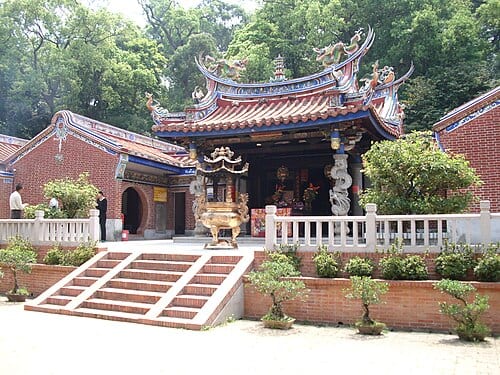
Huatan Hushan Rock Temple is a Guanyin temple in Huatan Township, Changhua County, founded in 1747 (the 12th year of the Qianlong reign); it takes its name from the hill on which it sits, whose shape resembles a reclining tiger, and is now a county-designated historic site. According to legend, a cowherd had already built a thatched shrine here to worship a clay Guanyin statue as early as 1730 (the 8th year of the Yongzheng reign). 'Tiger Rock Listening to Bamboo' was already counted among the Changhua Eight Sceneries in the Qing dynasty, and the temple is one of Changhua's three major hillside temples alongside Bishan Rock and Qingshui Rock, combining religious pilgrimage with appreciation of the natural surroundings.
Huatan Hushan Rock Temple was founded in 1747, the 12th year of the Qianlong reign; legend holds that a cowherd had already built a thatched shrine here to worship a clay Guanyin statue as early as 1730, marking the site's religious origins. 'Tiger Rock Listening to Bamboo' was already counted among the Changhua Eight Sceneries in the Qing dynasty, and the temple is one of Changhua's three major hillside temples, alongside Bishan Rock and Qingshui Rock.
Highlights of Huatan Hushan Rock Temple
Hushan Rock Temple is built on the midslope of Hushan, on the southern section of the Bagua Mountain Range. The temple buildings are arranged in tiers along the hillside; the uppermost hall looks down over the plain of Huatan Township and the distant mountains. The architecture retains some Qing dynasty wooden elements; successive restorations have incorporated craft styles from different eras. A bamboo grove beside the temple is quiet and peaceful — the name "Tiger Rock Listening to Bamboo" comes from the sound of bamboo leaves rustling here, an atmospheric experience still available in the early morning or evening.
Climbing the stone steps from the forecourt plaza, the temple body reveals itself tier by tier, combining the ceremonial sense of a religious building's spatial sequence with the enveloping sensation of the natural environment. A hiking trail behind the temple continues upward through dense forest shade — well suited for morning hikes. The temple is an important religious center for the local community; around the 19th day of the second lunar month — Guanyin Bodhisattva's birthday — worshippers crowd in, temporary vendor stalls set up in the forecourt, and the atmosphere is completely different from ordinary days.
Tips for Getting the Most Out of Your Visit
Practical Information
Getting There & Visiting Hours
- Driving is most convenient. Head south from Changhua City along Provincial Highway 1 to Huatan, then turn off onto Hushan Street following the signs; there is a car park in front of the temple.
- The temple is open year-round at no charge. The 6–9 a.m. period on weekday mornings is popular with hikers; weekday afternoons are quieter. Traffic around the birthday observance can be congested.
Nearby Connections
- Huatan Township has local snacks such as white ghost-woman herb rice cakes (bai fanpo caoziguo); after visiting, explore the food options around Huatan Market.
- The Bagua Mountain Range trail system extends north toward Baguashan Great Buddha Scenic Area; those with the energy can hike the ridgeline trail to connect the two sites.
Sources: Changhua County Cultural Affairs Bureau; Huatan Township Office.
Frequently Asked Questions
When was Huatan Hushan Rock Temple founded?
It was founded in 1747, the 12th year of the Qianlong reign; legend says a cowherd had already built a thatched shrine here to worship Guanyin as early as 1730.
What does 'Tiger Rock Listening to Bamboo' refer to?
It is one of the Qing dynasty's Changhua Eight Sceneries, referring to the sound of bamboo leaves rustling beside the temple; the temple is one of Changhua's three major hillside temples along with Bishan Rock and Qingshui Rock.
Sources
- 虎山巖 - 維基百科 — 乾隆12年(1747年)創建、彰化八景沿革
- 虎山巖-臺灣宗教文化地圖-臺灣宗教文化資產 — 官方宗教文化資產資料