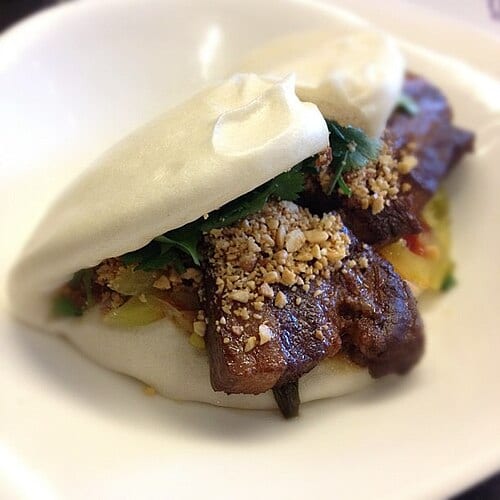
Gua bao is a traditional Taiwanese street food: a half-moon steamed bun, known as a lotus-leaf bun, filled with braised pork belly, pickled mustard greens, peanut powder, and cilantro, and nicknamed 'tiger bites pig' in Hokkien for its bite-shaped opening. Lan Jia Gua Bao in Gongguan, started roughly 30 years ago when owner Lan Feng-rong turned his mother's home recipe into a stall business, has become Taipei's best-known gua bao shop and put this traditional snack on the tourist trail. But the roots of gua bao lie in the old stalls of Guangzhou Street Night Market in Wanhua.
Lan Jia Gua Bao in Taipei's Gongguan district was started roughly 30 years ago by owner Lan Feng-rong, based on his mother's home recipe. It has been named to the Michelin Guide Taipei's Bib Gourmand list in multiple years since 2019 — the first gua bao shop to receive this recognition — and reportedly sells around 2,000 to 3,000 buns a day.
What is Gua Bao
Gua bao uses a half-moon lotus-leaf bun (a leavened, steamed dough folded over into a lotus-leaf shape). The core filling: long-braised sliced pork belly (braised until tender with soy sauce, rock sugar, rice wine, star anise, and other spices), locally pickled mustard greens, finely ground peanut powder, and cilantro. The pork is tender and glossy with fat; the fermented tartness of the pickled greens cuts through the richness of the meat; the peanut powder adds a nutty sweetness; the bun itself has a mild wheat fragrance and a pleasant chew. These four elements together deliver a layered, satisfying bite.
Gua bao has ritual roots in Taiwan's Hokkien food tradition. The custom of offering gua bao to the earth god on Tail Ya Day (the 16th of the 12th lunar month) still exists in some areas. The everyday sold-at-market version evolved from temple-front culture in the Wanhua Guangzhou Street area. Lan Jia Gua Bao is located in the Gongguan district (near the intersection of Roosevelt Road and Tingzhou Road), known for its house-made bun skin and specially prepared pickled mustard greens. High media coverage has made the queue a constant, and it now appears on most Taipei visitor itineraries.
How to eat it the local way
Local knowledge
Objective background
- Gua bao uses a half-moon lotus-leaf bun filled with long-braised pork belly, pickled mustard greens, peanut powder, and cilantro. The pork is braised slowly with soy sauce, sugar, and spices until tender. It is a traditional Taiwanese street food also known as 'tiger bites pig.'
- Lan Jia Gua Bao has been in the Gongguan area of Taipei for many years and is known for its house-made bun skin and specially prepared pickled mustard greens. It is one of the most frequently cited gua bao shops in Taipei media.
Practical tips
- Lan Jia Gua Bao is open from the afternoon into the evening. Weekend queues can exceed 30 minutes; weekday crowds are lighter. A weekday early evening visit is a good call.
- Old stalls in Guangzhou Street Night Market selling gua bao operate on unpredictable hours — finding one open is a matter of luck. Lan Jia is the more reliable option.
- About a five-minute walk from MRT Gongguan Station to Lan Jia. Parking is limited; public transport is the better choice.
Source: records of traditional Taiwanese street food culture and fieldwork in the Gongguan district.
Frequently Asked Questions
Why is gua bao called 'tiger bites pig' in Hokkien?
Because the folded lotus-leaf bun clamping down on the braised pork resembles a tiger's open mouth biting into meat.
How long has Lan Jia Gua Bao been open?
Lan Jia Gua Bao started roughly 30 years ago when owner Lan Feng-rong turned his mother's home recipe into a street stall, and it is now a queue-worthy Gongguan landmark.
Has Lan Jia Gua Bao received Michelin recognition?
Yes, it has been named to the Michelin Guide Taipei's Bib Gourmand list in multiple years since 2019, the first gua bao shop to earn this recognition.
What fillings go inside a traditional gua bao?
A traditional gua bao holds braised pork belly, pickled mustard greens, peanut powder, and cilantro, layering savory, tangy, nutty, and fresh notes.
Sources
- NOWnews—1/26尾牙吃刈包!全台「5名店」必吃:必比登推薦、獨家豬舌刈包 — 新聞報導,確認藍家割包獲米其林必比登推介、約30年開業史
- 米其林指南—必比登推介:藍家割包 — 米其林指南官方文章頁面(原文因爬蟲限制無法直接擷取,已以多方獨立媒體報導交叉驗證其內容)