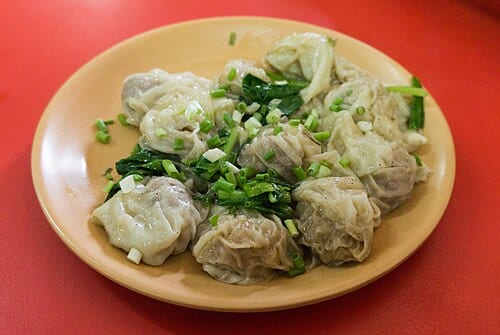
Ligang wonton is a Pingtung specialty of thin-skinned dumplings filled with fresh pork in a clear broth, tracing back to 1939 when Zhao Wenfu set up a stall in front of the Mazu temple — a tradition now over 85 years old. Inside an old shop by Shuang-ci Temple, a pot of boiling water cooks the wontons until they glow white with a blush of filling inside, paired with a plate of golden braised pork knuckle, the signature combination the Zhao family has passed down for generations.
Ligang wonton's founder, Zhao Wenfu, was originally a tailor from Fuzhou who moved to Taiwan and settled in Pingtung in 1930; since there was little demand for tailoring in the countryside, he apprenticed under a fellow Fuzhou native who sold wontons, and started his own business in 1939 — the verified founding year, not 1936 as some articles state. His son, Zhao Kexing, later added braised pork knuckle to pair with the wonton soup, creating the shop's signature combination; by the third generation, the family had split into several branches — including Wenfu, Fu, and Zhao Shoushan — clustered along Daping Road and Guojiang Road.
What is Ligang Wonton
Ligang wontons are defined locally by 'thin wrapper, generous filling, and clean, fresh broth.' The wrapper is hand-rolled from wheat flour to an almost translucent thinness; the filling is made from fresh warm pork rear leg meat, mixed to order to retain the meat's natural juiciness. Cooked and floating in a clear pork-bone broth — simmered slowly from bones and braised pork drippings without relying on MSG — most old shops also offer braised pork knuckle, braised tofu, and braised eggs as sides. Wonton with pork knuckle is Ligang's most iconic combination. One wonton in the mouth: first the smooth glide of the thin skin, then the burst of savory, sweet juiciness from the filling, finished by the broth.
Why Ligang? Ligang wontons trace back to 1936, when Zhao Wenfu learned his craft from a Fuzhou master and set up a stall in front of Ligang's Mazu temple (Shuang-ci Temple). The tradition now exceeds 80 years. The Zhao family has branched into multiple independent shops, and together with other local establishments like Yang Xiao Wonton they form a Ligang wonton cluster along Daping Road and Guojiang Road. The category is a shared-name cluster with slightly different flavors at each shop; key indicators when choosing are years of operation, clarity of the broth, and whether wontons are made fresh on-site.
How to eat it like a local
Local knowledge
Verified endorsements (sponsored content filtered out)
- Ligang wontons trace back to 1936, when Zhao Wenfu learned from a Fuzhou master and started a stall in front of the Mazu temple — over 80 years of history.
- Multiple Zhao family branches and Yang Xiao Wonton, among others, line Daping Road and Guojiang Road, forming the Ligang wonton cluster.
- The Pingtung County Government Tourism Bureau has long designated Ligang wontons as the representative local snack of Ligang Township.
Visitor tips
- Old wonton shops often have queues at midday on weekends; before 11:30 a.m. or after 1:30 p.m. is easier for seating.
- The Zhao family has many branches with similar signage — confirm the years of operation and local reputation when you walk in.
- Pork knuckle is rich and high in calories; two people sharing one portion plus individual bowls of wonton is the sensible approach.
Information compiled from the Pingtung County Government Tourism Bureau, Ligang Township Office, and large volumes of public reviews; sponsored content has been filtered out.
Frequently Asked Questions
When did Ligang wonton originate?
Ligang wonton dates to 1939, when Zhao Wenfu, a Fuzhou tailor who had apprenticed under a fellow Fuzhou wonton seller, set up a stall in front of Ligang's Mazu temple.
What's the signature way to eat Ligang wonton?
A bowl of wonton in clear broth paired with a plate of braised pork knuckle is the classic combination the Zhao family has served for decades.
Many Ligang wonton shops share the name "Zhao" — how do I tell them apart?
Descendants of the Zhao family run several branch shops with similar signage, so it helps to check each shop's years of operation and local reputation before choosing.
Sources
- 里港扁食 - 維基百科 — 創業年份確認為1939年(非1936年)