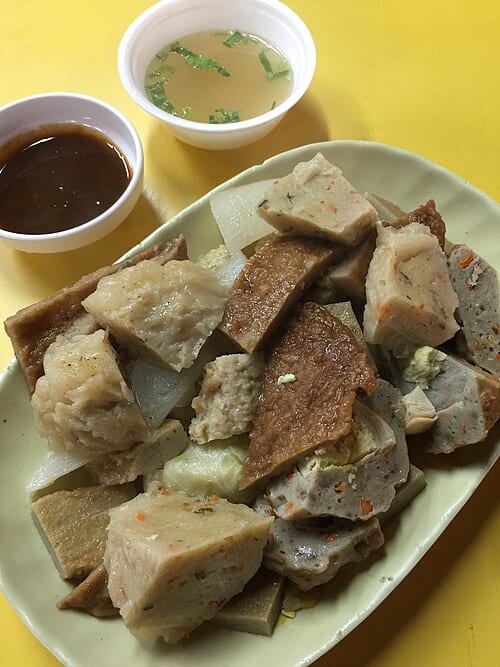
Black wheel (hei lun) is a Keelung Temple Street snack made from fish paste, slow-simmered in a kelp-and-bonito broth until the flavor soaks in; the Taiwanese name o͘-lián is a phonetic loanword from the Japanese oden. The pot at a Temple Street hei lun stall is always warm, with flat and tubular fish cakes bobbing in the broth as their color shifts from white to light brown. Despite sharing an etymological root, hei lun broke away from the Japanese hot-pot format of simmering konjac, daikon, and eggs together as it localized in Taiwan, evolving into its own category centered entirely on fish paste. It shares the same origin as the equally common tempura at Temple Street but differs in cooking method — tempura is batter-fried, while hei lun is simmered.
The Taiwanese term o͘-lián is a phonetic loanword from the Japanese oden, an etymology documented in Liu Chien-jen's research on the origins of Taiwanese vocabulary. According to a CommonWealth/TAI Sounding Taiwan roundup, northern Taiwan tends to call fried fish-paste products "tempura," while southern Taiwan's "hei lun" is usually long and simmered in bone broth; Keelung Temple Street's hei lun belongs to this simmered category, clearly distinct in method from the equally common, deep-fried tempura.
What is Black Wheel (Hei Lun)
Keelung Temple Street's hei lun is primarily composed of fish cakes made from fish paste, in a variety of shapes: the most common include flat fish cake, tubular fish cake (resembling chikuwa), and stuffed versions filled with ingredients like cabbage. The fish cakes are formed in advance and then placed in a broth made from kelp, bonito, or pork bone, where they slow-simmer for an extended period so the broth soaks into the interior. After long simmering, the fish cakes deepen in color, lose a little springiness but absorb the broth fully. Eaten with sweet chili sauce or soy sauce paste, the savory-sweet condiment layers over the fresh flavor of the fish paste. The key difference between hei lun and tempura lies in the cooking method: hei lun is water-cooked, tempura is deep-fried.
The spread of hei lun in Taiwan is directly tied to the culinary influence of the Japanese colonial period; the Taiwanese pronunciation o͘-lián corresponds directly to the Japanese oden. However, during Taiwan's localization process, hei lun departed from the Japanese hot pot format — which simmers a wide variety of ingredients like konjac, daikon radish, and eggs together — and evolved into a local system centered entirely on fish paste products. The official Keelung Temple Street introduction specifically notes that hei lun and tempura are distinct items to avoid confusion: both are based on fish paste, but one is fried and one is simmered, resulting in completely different textures and appearances.
How to eat like a local
Local knowledge
Objective credentials
- The official Keelung Temple Street Night Market introduction clearly identifies hei lun and tempura as distinct items, each listed separately in the Temple Street snack catalog.
- The Taiwanese term o͘-lián derives from the Japanese oden; this etymological connection is documented in Taiwan food culture research literature.
- Hei lun stalls are long-standing fixtures at Temple Street, available year-round with no seasonal interruption.
Visitor tips
- Hei lun stalls at Temple Street are concentrated along the Temple Street section of Ren 3rd Road and the area around Xiao 3rd Road, with service primarily in the evening.
- Hei lun is a slow-simmered item kept warm in the broth at all times — ready to pick up immediately, no wait for fresh preparation.
- Some stalls serve both hei lun and tempura. When ordering, you can refer to items by name or simply point at what you want on the stall's display.
Sources: Keelung Temple Street Night Market official introduction; research on Japanese loanwords in Taiwan's food culture.
Frequently Asked Questions
What does the Taiwanese term o͘-lián mean?
O͘-lián is a phonetic loanword from the Japanese oden, a result of culinary influence during the Japanese colonial period.
Are hei lun and tempura the same thing?
No — both use fish paste as their base, but hei lun is simmered in broth while tempura is deep-fried, giving them completely different textures and looks.
Is Keelung's hei lun the same as Japanese oden?
Not exactly — as it localized in Taiwan, hei lun moved away from the Japanese hot-pot format of simmering konjac, daikon, and eggs together, evolving into its own fish-paste-centered category.
What sauce does hei lun come with?
The standard dip at Temple Street is sweet chili sauce or soy sauce paste, each with its own fans.
Sources
- 黑輪(ɔ-lienˋ)──日語おでん(o-den) — 劉建仁《臺灣話的語源與理據》,黑輪語源考證
- 北部「天婦羅」v.s. 南部「黑輪」,哪裡不一樣? — 太報/微笑台灣,北部天婦羅(炸)與南部黑輪(煮)差異