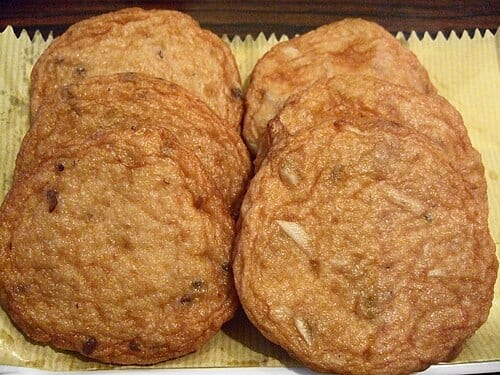
Marlin fish cake is a Taiwanese-style tempura fish cake made from marlin paste on Cijin Island in Kaohsiung, either deep-fried fresh into a crisp "fried fish cake" or simmered in an oden pot as "simmered fish cake." Take the ferry from Gushan and five minutes later you're on Cijin; turn left out of the exit onto Cijin Old Street, where woks pop with oil and a bite of the golden-fried cake cracks lightly — the flavor Cijin locals have grown up on.
Long-running marlin fish cake shops in the Cijin and Qianjin areas emphasize fresh-ground paste: Xiang Si Hai has operated for over 20 years since its 1997 founding, and Yihua Marlin Fish Cake has run for 21 years. Both use a two-stage fry — low heat to set the marlin paste, then high heat for a golden crust (source: Takao Pictorial, Kaohsiung City Government Information Bureau).
What is Marlin Fish Cake?
Marlin fish cake is a Taiwanese-style tian bu la / black wheel (oden) made primarily from marlin paste. Marlin is low in fat, white-fleshed, and naturally springy when ground into paste, shaped into rounds or flat pieces, and either deep-fried into "fried fish cake" or simmered in an oden hot pot as "simmered fish cake." Served with a drizzle of Taiwanese sweet sauce, a little chili sauce, and a scatter of scallion or cilantro — one bite is sweet, salty, and fishy all at once, the defining flavor of this port-side snack.
Cijin sits beside Qianzhen and Xingda fishing harbors, where marlin is an important near-shore catch. Fishing families traditionally ground the less presentable or broken pieces of marlin into paste to make fish cakes, tian bu la, and fish balls — and from this came "marlin fish cake" as a local specialty. Kaohsiung Tourism (the Kaohsiung City Government Tourism Bureau) lists marlin fish cake as one of the representative snacks of Cijin and Kaohsiung; a cluster of old fish cake shops and stalls lines Cijin Old Street, making it a category-tour kind of eat.
How to eat it like a local
Local knowledge
Objective credentials (filtered for sponsored content)
- Kaohsiung Tourism (official) lists marlin fish cake as one of the representative snacks of Cijin and Kaohsiung.
- Cijin's proximity to Qianzhen and Xingda fishing harbors makes marlin processing a historically grounded local industry.
- This guide covers "Cijin Marlin Fish Cake" as a category. Multiple stalls along Old Street each have their own character — sampling from several is recommended.
Practical tips
- Take the ferry from Gushan Ferry Terminal — about 5 minutes to Cijin. You can bring a scooter on the ferry or explore on foot.
- Cijin Old Street gets crowded on weekends; the alleys are narrow, so watch for electric scooters and motorcycles.
- Combine with Cijin Lighthouse, the Star Tunnel, the Rainbow Church, and the beach for a half-day itinerary.
Information compiled from the Michelin Guide, Kaohsiung City Government Tourism Bureau, and a large body of public reviews, filtered for sponsored content.
Frequently Asked Questions
Is marlin fish cake the same as tian bu la?
Marlin fish cake is the southern Taiwanese term for deep-fried fish paste products cooked in an oden-style broth; northern Taiwan commonly uses "tian bu la" (from the Japanese "tempura") for the same category, so the two describe closely related snacks with regional naming differences.
Where's the best place to eat marlin fish cake?
Cijin Old Street is where marlin fish cake is most concentrated — turn left out of the Cijin ferry terminal and you're there, with several long-running stalls lining the street; eating as you walk is the local way.
Where does the marlin used in this dish come from?
Cijin sits near the Qianzhen and Xingda fishing harbors, where marlin is an important near-shore catch; fishing communities historically ground less presentable cuts of marlin into paste to make fish cakes, giving rise to this local snack.
Sources
- 【202111旬味特輯】現炸旗魚黑輪,停不下來的金黃誘惑 — 高雄市政府新聞局《高雄畫刊》介紹旗津旗魚黑輪店家歷史與做法