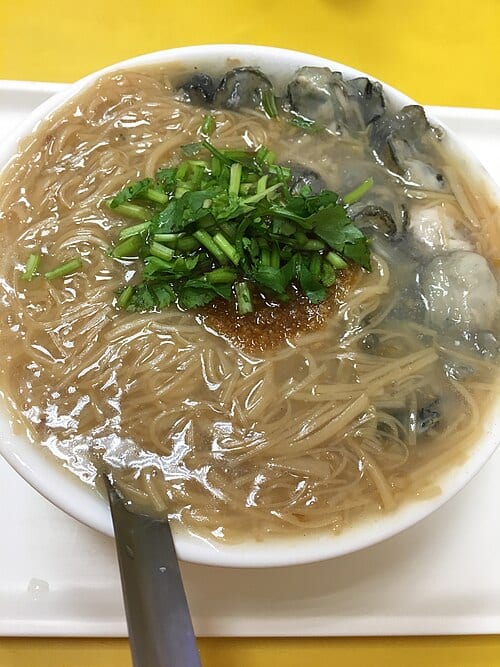
Oyster vermicelli soup is a thick-broth noodle dish found across Taiwan, made with fine handmade vermicelli in a sweet-potato-starch-thickened broth topped with freshly shucked oysters; the Sanmin district version in Kaohsiung, near the Japanese colonial-era Sanmin No. 1 Market, is built on a pork bone broth base that runs clearer than Tainan's pork-intestine-based rendition, each style with its own following.
Sanmin No. 1 Market was established during the Japanese colonial period and today stands at No. 285 Zhonghua 3rd Road in Kaohsiung's Sanmin District, near Sanfeng Temple — one of the city's longest-running traditional markets. Broth styles for oyster vermicelli soup vary by region across Taiwan; some Kaohsiung vendors use a pork bone broth that runs clearer, distinct from Tainan's common pork-intestine-based rendition, forming two different southern Taiwan styles. (Source: field records from saytainan.com, Wikipedia entry 'Oyster Vermicelli')
What is Oyster Vermicelli Soup?
Oyster vermicelli soup is a thick broth noodle found across Taiwan: fine handmade vermicelli soaked in a sweet potato starch–thickened broth with fresh oysters. The Sanmin version in Kaohsiung uses a pork bone base — the broth is clearer than Tainan's renditions, with a moderate thickness that doesn't become gluey, and the oysters, mostly sourced from the waters off Chiayi, are large and distinctly briny. A drizzle of house-made black vinegar and chili sauce from the owner rounds out the flavor, giving each bowl clearly layered depth.
Jianguo 3rd Road in Sanmin District developed alongside the area's traditional markets, with dense foot traffic feeding intense competition among stalls — which in turn has sustained quality. Vendors start prepping from 5:30 a.m. and close no later than 2 p.m., in step with the morning and midday market crowd. This "close when sold out" rhythm is one marker of a genuine old stall: if you can't make it early, you miss out.
How to eat it like a local
Local knowledge
Objective credentials
- The stretch of traditional market stalls around Jianguo 3rd Road in Sanmin District has long been a concentrated cluster of oyster vermicelli vendors and is recognized as a representative morning-to-midday market food zone in Kaohsiung.
- Kaohsiung's fresh oysters are largely sourced from aquaculture off the coast of Chiayi, delivered each morning before dawn. Vendors clean and prep them on-site, ensuring freshness.
- The pork bone thick broth approach is Kaohsiung's local style, distinct from Tainan's pork intestine-based version — two southern routes with their own followings.
Practical tips
- Parking near the market is limited. Taking the MRT to Sanmin Jiashang Station and walking is recommended, or arriving early when traffic is lighter.
- Flavor varies from stall to stall. Sampling multiple vendors in the same block is the best way to find the broth thickness you prefer.
- Seating is plastic chairs and folding tables, utilitarian at best, but turnover is fast — no long waits for a seat if you're eating in.
Source: Field records from the traditional market along Jianguo 3rd Road, Sanmin District, Kaohsiung.
Frequently Asked Questions
How is Kaohsiung's oyster vermicelli soup different from Tainan's?
Some Kaohsiung vendors use a clearer pork bone broth, while Tainan's common version relies on pork intestine, forming two distinct southern Taiwan styles.
When was Sanmin No. 1 Market established?
Sanmin No. 1 Market was established during the Japanese colonial period and stands today at No. 285 Zhonghua 3rd Road in Kaohsiung's Sanmin District, one of the city's longest-running traditional markets.
Does oyster vermicelli soup always use a thickened broth?
Yes, the broth is thickened with sweet potato starch so it clings evenly to the thin vermicelli and oysters — a basic feature of the dish.
Sources
- 三民第一市場的日常|saytainan.com — 三民第一市場設立於日據時代,現址中華三路285號
- 蚵仔麵線 - 維基百科 — 蚵仔麵線品類基本定義與分類參考