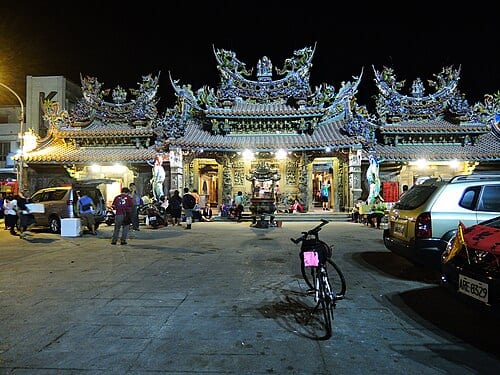
Mailiao Gonggfan Temple is a Mazu temple in Mailiao Township, Yunlin, built in 1685 during the Kangxi reign of the Qing dynasty and designated a national monument in 2012 — one of the oldest Mazu temples along Yunlin's coast. Mailiao Township sits on Yunlin's coast near the sixth naphtha cracker industrial zone. Surrounded by an industrial complex, the temple continues to serve as the local community's center of religious life; the everyday atmosphere of the snack stalls at the temple gate offers a window into daily life in Mailiao.
According to the National Cultural Heritage Database and Wikipedia, Gonggfan Temple was founded in 1685 (the 24th year of the Kangxi reign) when the monk Chunzhen brought a Mazu statue ashore at Haifeng Port; a flood on the Xin Huwei River forced a relocation to the current site (present-day Maifeng Village) in 1742. Taiwan's Ministry of Culture designated it a national monument on July 18, 2012, covering the front hall, worship hall, and main hall; the most recent full restoration was completed in 2018.
Highlights of Mailiao Gonggfan Temple
The wood and stone carvings in the front hall are the finest work in the temple — complex moldings, vivid narrative figures — with Qing-dynasty artisan skill relatively well preserved. The painted murals in the main hall also retain the Qing-dynasty style; colors have been touched up through restoration, but the overall layout follows the original arrangement. The temple is moderate in scale and serves mainly local worshippers; the atmosphere is everyday rather than commercial, offering a look at a coastal Taiwanese temple in its unadorned state.
Traditional food stalls cluster at the temple gate, serving as a gathering point for local Mailiao cuisine. The coast provides abundant seafood, and stalls near the gate sell seafood congee, fresh oyster products, and other dishes made from local catch — affordable prices reflecting a fishing-farming mixed local economy. The stretch of Zhongzheng Road around the temple retains the scale of a small-town main street, a chance to observe what a small town on Taiwan's western coast looks like.
How to make the most of your visit
Practical information
Getting there and hours
- The temple is open year-round with no regular closed day. Snack stalls operate mainly during the day; some close by evening.
- Public transport to Mailiao Township is limited; driving is recommended. Take Provincial Highway 17 or a county road into central Mailiao. Parking beside the temple is easy on weekdays.
Nearby connections
- Heading south along Provincial Highway 17 reaches Chenglong Wetlands in Kouhu Township, about thirty kilometers along the coast. Heading east is Huwei Township, about twenty kilometers away.
- Across the Zhuoshui River from Mailiao is Fangyuan Township in Changhua County; the Yunlin–Changhua coastal wetland ecology can be explored further.
Sources: Cultural Heritage Bureau (Ministry of Culture) Monument Database, Yunlin County Government Tourism Information.
Frequently Asked Questions
When was Mailiao Gonggfan Temple built?
It was founded in 1685, the 24th year of the Kangxi reign, after the monk Chunzhen brought a Mazu statue ashore at Haifeng Port — more than three centuries ago.
When was it designated a national monument?
Taiwan's Ministry of Culture designated it a national monument on July 18, 2012, covering the front hall, worship hall, and main hall.
How is Gonggfan Temple related to Beigang Chaotian Temple?
Both are major Mazu temples in Yunlin; Gonggfan Temple, Beigang Chaotian Temple, Taixi Anxi Temple, and Baozhong Mamingshan Zhen'an Temple are together called Yunlin's "four great temples," though each is independently managed.
Sources
- 國定古蹟麥寮拱範宮 - 國家文化資產網 — 國定古蹟公告資訊與指定範圍
- 麥寮拱範宮 - 維基百科 — 建廟與遷址年份