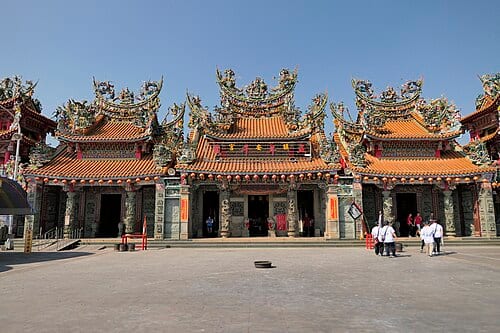
Baozhong Maming Temple (Zhenan Palace) is a Wang Ye temple in Baozhong Township, Yunlin County, commonly known as the "General Temple of the Five-Year Thousand Years Deities," dedicated to the Five-Year Thousand Years Deities (also called the Twelve Lords), with a temple history tracing to a 1662 legend of a Wang Ship drifting ashore at Maming Hill.
The principal deity of Maming Temple is the "Five-Year Thousand Years Deities" (also honored as the Twelve Lords) — not a single deity named Chi Fu Qian Sui. Temple history traces to 1662 (Yongli 16 under Ming loyalist rule, Kangxi 1 under Qing), when a Wang Ship is said to have drifted ashore at Maming Hill carrying three deity statues and a red silk banner recording the surnames and birthdates of the Twelve Lords; settlers from seven villages, including Malongshan, raised funds to build the temple. It was rebuilt in brick in 1887 (Guangxu 13); a congregation assembly voted for full reconstruction in 1947, the old temple was demolished in 1951, and the new one completed in 1952. The "Five-Year Grand Ceremony" procession is held in the lunar Tiger, Horse, and Dog years — once every four solar years, called "five-year" under traditional Chinese inclusive counting — making this the progenitor temple of the Five-Year Thousand Years Deities faith across Taiwan and a nationally designated Important Folk Custom.
Highlights of Maming Temple
The Lord Chi enshrined at Zhenan Palace belongs to Taiwan's Five-Year Wang Ye faith system, centered on driving away pestilence and protecting communities. The Five-Year Grand Ceremony procession, held once every five years, is regarded as the highest celebration of the Five-Year Wang Ye faith across Taiwan. The temple is among the larger coastal Yunlin temples; the incense banners from temples across Taiwan that hang in its halls document the network of connections among sub-temples throughout the country, providing a concrete object for understanding the organizational structure of Taiwan's temple faith.
During the Five-Year Grand Ceremony, pilgrimage groups from across Taiwan converge on Baozhong; the procession is enormous in scale and diverse in performance arts, including Songjiang Battle Array, Eight Generals, and Electronic Music Third Prince — mixing traditional and contemporary folk performance forms. During the event, visitor numbers in Baozhong Township far exceed normal levels, creating one of the rare large-scale temple fair spectacles in Yunlin County. In non-Grand Ceremony years, the temple maintains regular incense offerings with a comparatively quiet atmosphere.
How to Make the Most of Your Visit
Practical Information
Getting There and Time
- Baozhong Township has no train station; driving is the primary option. From Beigang the drive is about 20 minutes; from Douliu about 40 minutes.
- The temple is generally open all day. During the Five-Year Grand Ceremony, traffic restrictions are in place; check traffic guidance from the temple and Baozhong Township Office in advance.
- The Grand Ceremony also has evening programs; if you plan to attend at night, arrange accommodation, with options mainly in neighboring townships.
Nearby Connections
- Can be paired with Tuku Shuntian Temple and the Sihu Taiwan Tilapia Aquaculture Area to plan a full-day Yunlin coastal culture and agricultural fisheries route.
- Taixi Seaside Park is about a 30-minute drive from Baozhong and can be extended to take in ocean views and sunset.
Sources: Temple records and documentation on Taiwan folk faith.
Frequently Asked Questions
Which deity does Maming Temple's main hall enshrine?
It enshrines the "Five-Year Thousand Years Deities," honored as the Twelve Lords under Taoism's twelve-plague-king tradition — not a single deity called Chi Fu Qian Sui.
When does Maming Temple's history begin?
Its history is traditionally traced to 1662, when a Wang Ship is said to have drifted ashore at Maming Hill and settlers from seven villages raised funds to build a temple for its deity statues.
Is the Five-Year Grand Ceremony really held every five years?
It is held in the lunar Tiger, Horse, and Dog years, which works out to about once every four solar years — it's called "five-year" under traditional Chinese inclusive counting.
Sources
- 馬鳴山鎮安宮─五年千歲祖廟:歷史沿革 — 馬鳴山鎮安宮官方網站,記載建廟傳說、重修沿革與五年千歲信仰
- 馬鳴山鎮安宮 - 維基百科 — 補充主祀神明、五年大科舉辦週期資訊