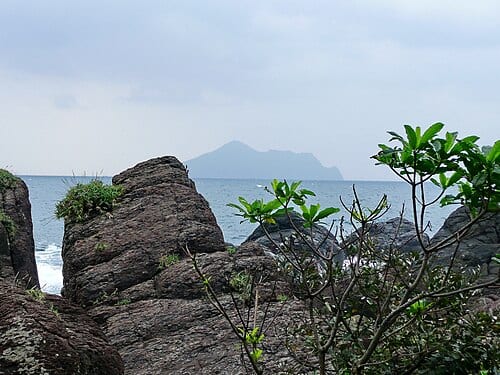
Beiguan Tidal Park is a coastal park on Binhai Road in Toucheng Township, formed on the Qiangou Formation of shale interbedded with fine sandstone, where long-term differential wave erosion has carved tofu-block rocks and cuesta ridges. The park also preserves the ruins and stone marker of the Qing-dynasty Beiguan checkpoint, with trails allowing close-up views of the reef terrain — one of the representative scenic spots along Yilan's northern coast.
The park's bedrock belongs to the Qiangou Formation, dating to the Oligocene (roughly 30 million years ago), consisting of dark grey hard shale interbedded with muddy fine sandstone or siltstone, over 800 metres thick; the softer lower shale erodes faster than the sandstone above it, producing a cuesta landform, while erosion along rock joints has carved the park's signature tofu-block rock formations — this is sedimentary rock, not basalt.
Highlights of Beiguan Tidal Park
The name Beiguan (Northern Pass) comes from the Qing-dynasty defence system: this was the northern gateway into the Yilan Basin, and the surviving stone marker records the establishment of the pass. Geologically, this section of coastline is volcanic-rock reef terrain; the basalt has been eroded by waves over time into a variety of reef formations, and the intertidal zone is ecologically rich. The park's trail follows the reef coastline and descends to lower reef platforms — but always check wave conditions for safety.
Beiguan is at the northern tip of Yilan County, right along Provincial Highway 2. It is about a 5–10-minute walk from the car park to the main viewpoints. When waves are large — especially during the northeast monsoon season (roughly October through March) — the spray is spectacular, but the reef surface is slippery and you must stay out of any warning zones. In summer the sea is calmer, making it safer to observe the reef ecology up close.
How to Make the Most of Your Visit
Practical Information
Getting There
- By car: drive along Provincial Highway 2 to the northern end of Toucheng Township; Beiguan Tidal Park is signposted from the road and has a car park.
- By public transit: take the TRA to Toucheng Station, then take a taxi or local bus — about 15 minutes. Check schedules in advance as services may be infrequent.
- When waves are high, the reef surface is dangerously slippery. Follow all warning signs; do not enter any reef area that waves can reach.
Nearby Connections
- Wushih Harbor Tourism Fishing Port is about 2 km to the south and can be combined with Guishan Island or whale-watching plans to form a northern Toucheng half-day route.
- Toucheng Old Street is about 5 km to the south; the afternoon is a good time to browse the traditional buildings and have a meal.
Source: Yilan County Cultural Affairs Bureau and on-site park interpretive materials.
Frequently Asked Questions
What type of rock forms the Beiguan reef coastline?
The bedrock belongs to the Qiangou Formation — dark grey hard shale interbedded with muddy fine sandstone or siltstone — not basalt.
What are the 'tofu rocks' at Beiguan?
Tofu rocks form where long-term wave erosion cuts along the rock's natural joints, carving the shale and sandstone into block-like shapes resembling cut tofu.
Where does the name Beiguan come from?
Beiguan comes from the Qing-dynasty defence system; it was the northern gateway checkpoint into the Yilan Basin, and a Qing-era stone marker survives in the park today.
Sources
- 北關海潮公園 - 東北角及宜蘭海岸國家風景區觀光資訊網 — 官方景點介紹
- 蘭陽博物館電子報:地質(二)~北關地質景觀 — 乾溝層地質構造與豆腐岩、單面山成因