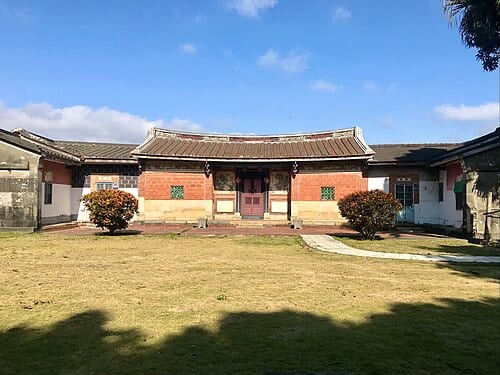
Xiaoyun Manor is a scholarly residence in Sanjiao Village, Shengang District, Taichung, built in 1866 (the 5th year of the Qing Tongzhi era) by the Lu family, beginning with Lu Bingnan's construction of the Duqing Hall; his sons Lu Ruyu and Lu Rushiu added the guest pavilion, flanking wings, and the book-filled Xiaoyun Study in 1878. The compound is one of the most completely preserved Qing dynasty courtyard residences in the Taichung area and a witness to the settlement and educational history of the Sanjiao community in Shengang.
Xiaoyun Manor was built by Lu Bingnan starting in 1866 (Tongzhi 5th year), beginning with the Duqing Hall; his sons Lu Ruyu and Lu Rushiu added the guest pavilion, flanking wings, and the Xiaoyun Study in 1878, with a further modern-style addition in 1933 (Showa 8th year) — spanning multiple construction phases from the late Qing into the Japanese colonial period, per the Chinese Wikipedia entry and the Taichung City Cultural Heritage Bureau. The Lu family earned a reputation as a distinguished scholarly household for its emphasis on education and its extensive book collection, and the manor is now designated a Taichung municipal historic site.
Highlights of Xiaoyun Manor
Xiaoyun Manor was built during the Qing Xianfeng era by the Lu family of Shengang. The family's emphasis on education and culture earned them a reputation as a distinguished scholarly household. The residence follows the traditional southern Fujian courtyard layout, with the main hall and flanking wings arranged in a clear hierarchy around a formal inner courtyard complemented by covered corridors and plantings. The carved and painted woodwork on the architectural members and the stonework construction techniques preserve the craftsmanship of Qing dynasty artisans, making this an unmissable example for the study of traditional Taiwanese residential architecture.
The Sanjiao settlement in Shengang District retains multiple architectural remnants of Qing dynasty Han settler communities, reflecting the early agricultural history of the central Taiwan plains. The area is also known for its traditional pastry industry; local specialties such as fengyangao (almond-shaped rice cakes) continue to be made here to this day. The cultural hall's displays also cover the community's food craft heritage, allowing visitors to learn about the settlement's industrial history beyond the architecture.
How to Make the Most of Your Visit
Practical Information
Getting There & Timing
- Drive from central Taichung north along Zhongqing Road and turn toward Shengang District; use navigation to confirm the latest route.
- Xiaoyun Manor is a private residence. Check with the Shengang District Office or the relevant authority in advance to confirm visiting hours and access arrangements.
- A weekday visit is recommended, as weekend crowds are heavier and some areas may have restricted entry.
Nearby Connections
- Shengang is about 20 to 30 minutes from central Taichung by car and can be combined with Fengyuan Old Street or the Daya wheat fields (seasonal, February–March) for a half-day trip.
- You can continue to other traditional settlements in Shengang District to explore historical remnants of Qing dynasty land settlement and pioneer history.
Source: Facts compiled from the Wikipedia entry on Xiaoyun Manor.
Frequently Asked Questions
When was Xiaoyun Manor built?
Xiaoyun Manor was built by Lu Bingnan starting in 1866, with several later phases of expansion.
Why is the Lu family known as a scholarly household?
The family placed great emphasis on education and book collecting, and the manor's Xiaoyun Study housed an extensive library, earning them the reputation of a distinguished scholarly household.
What are the architectural features of Xiaoyun Manor?
The compound follows a traditional southern Fujian courtyard layout and is one of the most completely preserved Qing dynasty residences in Taichung, expanded in phases from the late Qing into the Japanese colonial era.
Sources
- 筱雲山莊-維基百科 — 建造年份(同治5年/1866年)與分期擴建沿革
- 市定古蹟-神岡區「筱雲山莊」-臺中市文化資產處 — 官方古蹟資料交叉核對