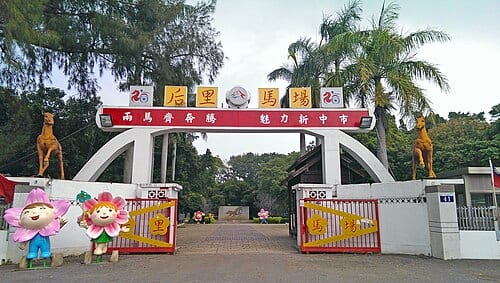
Houli Horse Ranch is a former Taichung Prefecture Horse Production Ranch established in 1937 during the Japanese colonial period in Taichung's Houli District. After the war it was first run by the Taichung County Farmers' Association, then taken over by the military in 1952 as the Joint Logistics Taiwan Stud Farm, and only transferred to the Taichung County Government in 1997 to become the nation's only publicly run horse ranch. The park retains its Japanese-Western hybrid stable and headquarters buildings, making it the only one of Taiwan's nine Japanese-era horse ranches to survive intact.
Houli Horse Ranch originated as the Taichung Prefecture Horse Production Ranch, established in 1937 during the Japanese colonial era on about 11 hectares; its headquarters and first two stables were built around 1938, designed by the Taichung Prefecture Civil Engineering Section, per the Chinese Wikipedia entry and the National Cultural Heritage Database. After the war it was initially run by the Taichung County Farmers' Association, then taken over by the military in 1952 as the Joint Logistics Taiwan Stud Farm, and was not transferred to the Taichung County Government until 1997, becoming the nation's only publicly run horse ranch; its stables, headquarters, and two monuments were designated a Taichung municipal historic site in 2016.
Highlights of Houli Horse Ranch
The ranch was built in 1936 on the Houli Plateau, whose flat terrain was well suited for raising military horses. The building complex uses Japanese timber-frame construction, with red-tiled pitched-roof stables and staff dormitories arranged along a main axis in a clearly ordered spatial sequence. After the war, the Taiwan Sugar Corporation took over and continued using the site primarily for equestrian training. Only in recent years, when it was redeveloped as an equestrian park and opened to the public, did it begin hosting cultural events and visitor activities.
The park holds regular equestrian competitions and demonstration performances, and riding experience courses are open for general public registration. Parts of the Japanese dormitory cluster have been partially restored and are used intermittently for exhibitions and arts events. The main buildings retain well-preserved timber joinery and roof truss details — visitors with an interest in architectural history or Japanese colonial culture are encouraged to take a close look at the construction techniques.
How to Make the Most of Your Visit
Practical Information
Getting There & Timing
- Drive or ride to Taian Road in Houli District. The park has a parking lot.
- Take the Taiwan Railways to Houli Station, then transfer by bus or taxi — about a 10 to 15 minute ride.
- Opening hours and admission fees are subject to park announcements; check official information before you go.
Nearby Connections
- The Yueyuan Sugar Factory ruins and Lihpao Resort are nearby in Houli District, allowing for a half-day to full-day itinerary combining multiple stops.
- The Taian Railway Cultural Park is not far away and shares a Japanese railway history background, making it a natural add-on for visitors interested in modern history.
Source: Facts compiled from the Wikipedia entry on Houli Horse Ranch.
Frequently Asked Questions
When was Houli Horse Ranch established?
Its predecessor, the Taichung Prefecture Horse Production Ranch, was established in 1937 during the Japanese colonial period.
Who operated Houli Horse Ranch after the war?
It was first run by the Taichung County Farmers' Association, then taken over by the military in 1952, and only transferred to the Taichung County Government in 1997.
What makes Houli Horse Ranch special?
It is the only one of Taiwan's nine Japanese-era horse ranches to survive with its buildings intact, and its stables and headquarters are now a Taichung municipal historic site.
Sources
- 后里馬場-維基百科 — 設立年份、戰後接管單位、1997年移交沿革
- 后里馬場-國家文化資產網 — 文化景觀官方登錄資料交叉核對