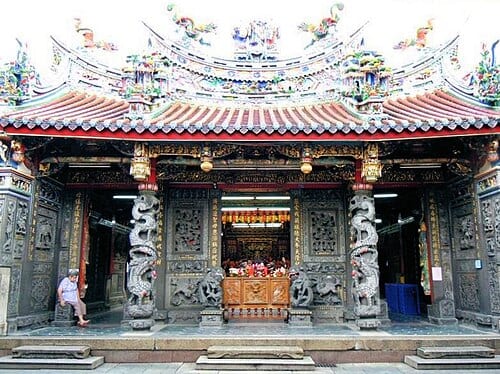
Fengyuan Ciji Temple is a Mazu temple in Taichung's Fengyuan District, whose predecessor, the Guanyin Pavilion, was founded in 1777 (Qianlong 42); in the early 19th century it was rededicated primarily to Mazu, with Guanyin as a secondary deity, and renamed Ciji Temple. The building burned down in 1853, was rebuilt and expanded during the Tongzhi and Guangxu eras, underwent further reconstruction starting in 1917, and was completed in 1933 — making it one of the oldest Mazu temples in northern Taichung.
The temple's predecessor, the Guanyin Pavilion, was founded in 1777 (Qianlong 42); in the early 19th century it was rededicated to Mazu as the primary deity, with Guanyin as secondary, and renamed Ciji Temple. Fire destroyed the building in 1853; Lin Zhu raised funds for repairs in 1864, and Lin Zhenfang led a rebuilding effort and land purchase in 1879 that established the temple's present scale. Further reconstruction began in 1917 during the Japanese colonial period and, after nine years, was completed in 1933.
Highlights of Fengyuan Ciji Temple
Fengyuan Ciji Temple was founded around the Qing Qianlong period (1736–1795), gradually taking shape alongside the Han settler communities developing the Fengyuan area, and became the central gathering place for local Han religious life. The temple has been rebuilt and expanded multiple times; the current layout preserves the traditional spatial arrangement of southern Fujian temple architecture, with the Sanchuan Hall, main hall, and rear hall arranged in sequence. The upswept swallowtail ridgelines and decorative craftsmanship are characteristic of traditional Taiwanese temple architecture.
Fengyuan Ciji Temple plays an important role in the religious and social life of the Fengyuan area, and the plaza in front of the temple is the main venue for festivals and civic events. Around the Mazu birthday on the 23rd day of the third lunar month, the temple holds grand ceremonies — an opportunity to observe Taiwanese folk religious culture firsthand. The Fengyuan Old Street nearby is worth a stroll on the same visit.
How to Make the Most of Your Visit
Practical Information
Getting There & Timing
- Fengyuan Ciji Temple is open year-round with no admission fee. Crowds are heavy during major festivals such as the Mazu birthday, so allow extra time for transportation.
- Take the Taiwan Railways to Fengyuan Station and walk about 10–15 minutes. By car, use street parking spaces or nearby parking lots.
Nearby Connections
- Fengyuan can be combined with Shigang Dam and the Dongshi Forestry Culture Park to plan a day trip along the northern mountain-line side of Taichung.
- Fengyuan Station offers convenient rail access, allowing you to connect to central Taichung or extend your trip toward Miaoli.
Source: Fengyuan Ciji Temple official information, Wikipedia entry on Fengyuan Ciji Temple.
Frequently Asked Questions
When was Fengyuan Ciji Temple founded?
Its predecessor, the Guanyin Pavilion, was founded in 1777.
Which deity did it originally enshrine?
It originally enshrined Guanyin; in the early 19th century Mazu became the principal deity with Guanyin as secondary, and the temple was renamed Ciji Temple.
When was the current scale of the temple established?
Lin Zhenfang's 1879 rebuilding and land purchase set the present scale; further reconstruction began in 1917 and was completed in 1933.
Has the temple ever burned down?
Yes, fire destroyed the building in 1853, and it was subsequently rebuilt several times.
Sources
- 豐原慈濟宮 - 維基百科 — 創建年份1777年與修建時間軸