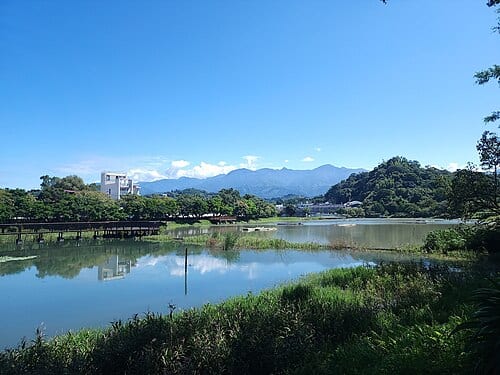
Dongshi Forestry Cultural Park is a forestry heritage site in Taichung's Dongshi District, occupying the former grounds of the Daxueshan Forestry Company, planned from 1956; its large sawmill broke ground in 1962 and opened on 26 May 1964, once the largest sawmill in East Asia and the first in Taiwan to adopt American-style integrated production. The company ceased operations in 1974, the site reopened as a cultural park in June 2013, and it was designated a cultural landscape in 2019 — an important place for understanding Taiwan's post-war forestry history.
The park occupies the former Daxueshan Forestry Company site, planned from 1956; its large sawmill broke ground in 1962 and was completed on 26 May 1964, once East Asia's largest sawmill and Taiwan's first to adopt American-style integrated timber production. The company ceased operations in 1974; the site opened to the public as a cultural park in June 2013 and was designated a cultural landscape on 14 June 2019.
Highlights of Dongshi Forestry Cultural Park
The Dongshi Forestry Station was established during the Japanese colonial period as an important base for managing the forest resources of the upper Dajia River watershed. It had its own forestry railway (the Dongshi Line) as the main artery for timber transport. After retrocession, it was taken over by the Taiwan Provincial Forestry Research Institute and continued to operate for several decades. After the railway ceased operations, the old facilities — including track sections, a locomotive shed, wooden housing clusters, and office buildings — were gradually conserved and restored, and the site was opened to the public as a cultural park.
The park presents the history of Taiwan's forestry development and preserves multiple Japanese-style wooden residential buildings, typical in layout and in good condition in terms of timber detailing. The forestry railway remnants provide a distinctive industrial heritage perspective; visitors interested in the history of Taiwan's mountain forest development will find much to explore here. Dongshi is a mountain town in the Dajia River valley, and the surrounding orchards and mountain scenery are additional reasons to visit.
How to Make the Most of Your Visit
Practical Information
Getting There & Hours
- For opening hours and admission fees for Dongshi Forestry Cultural Park, check the Taichung City Agriculture Bureau or official park announcements. Special exhibitions and activities are held from time to time.
- Dongshi is in the mountain town area on the eastern side of Taichung. By car, take Provincial Highway 3 to Dongshi and follow the signs; no direct public transport is available, so driving or chartering a car is recommended.
Nearby Connections
- Dongshi is known for its high-grafting pears and other fruit — the season is a good time to buy local produce. Guguan Hot Springs is nearby and can be added as a follow-up.
- Shigang Dam is close to Dongshi and can be combined with a 921 earthquake history education itinerary.
Sources: Taichung City Agriculture Bureau; Wikipedia entry on Dongshi Forestry Cultural Park.
Frequently Asked Questions
What was Dongshi Forestry Cultural Park originally?
The Daxueshan Forestry Company, planned from 1956 — a post-war facility, not a Japanese colonial-era forest station.
When was the large sawmill completed?
Construction began in 1962 and it opened on 26 May 1964.
What was significant about the Daxueshan Forestry Company?
It was East Asia's largest sawmill in the 1960s and the first in Taiwan to adopt American-style integrated timber production.
When did the site open to the public as a cultural park?
It opened in June 2013 and was designated a cultural landscape on 14 June 2019.
Sources
- 東勢林業文化園區 - 台灣山林悠遊網(林務局) — 大雪山林業公司歷史沿革與大製材廠時程
- 東勢林業文化園區 - 臺中市文化資產處 — 戰後建立、2019年公告文化景觀確認