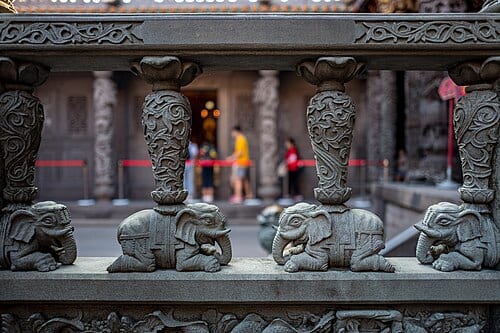
Sansia Qingshui Zushi Temple is a Qing-dynasty temple in New Taipei City's Sansia District, rebuilt three times over its history. Its current form dates to a postwar reconstruction directed from 1947 by painter Li Mei-shu, who treated the project as an artistic undertaking and brought in master carvers to render its stone pillars, wood carvings, and bronze work in fine detail. Although the pace of construction slowed sharply after the mid-1990s, parts of the temple remain unfinished today, and it continues to be regarded as a landmark of Taiwanese temple carving craftsmanship.
The temple's predecessor was built starting in 1767 and completed in 1769. It was damaged by an earthquake and rebuilt in 1833, burned down by Japanese troops in 1895, and rebuilt a second time in 1899. Painter Li Mei-shu led a third reconstruction starting in 1947, but overall work slowed sharply after 1996; of a planned total of 156 carved pillars, roughly 130 have been completed, and parts of the temple remain unfinished.
Highlights of Sansia Qingshui Zushi Temple
Each stone pillar in front of the temple is carved from a single block of granite into a dragon pillar with intricate detailing — divine beasts, flowers, and scenes from historical stories chiseled across the stone surface with great precision. The interior wood carvings are concentrated on the altar cabinet, beams, and coffered ceiling, executed in traditional southern Fujian timber-frame technique. The bronze elements, including door gods and railings, are the modern craft addition. The temple as a whole can be seen as a craft museum frozen mid-construction, since work stalled after 1996 with roughly 130 of a planned 156 carved pillars completed.
Because reconstruction stalled after 1996 rather than being finished off, the temple today shows a visible patchwork of fully carved sections next to plainer, never-completed ones — the biggest distinction between Qingshui Zushi Temple and a typical completed temple. The temple has interpretive materials introducing Li Mei-shu and the reconstruction project's history; reading them before entering the main hall helps you understand why some areas remain unfinished and observe each section's craftsmanship from an artistic perspective.
How to make the most of your visit
Practical information
Getting there & timing
- From Taipei MRT Fuzhong Station, transfer to a bus to Sansia. By car, take Provincial Highway 3; parking near the temple is relatively convenient, though you may need to circle for a space on weekends.
- The temple is open daily; entry to the religious space is free. Opening hours follow on-site announcements; it can be noisy and crowded during incense-burning periods.
Nearby connections
- Sansia Old Street is a short walk from the temple, with well-preserved arcade buildings, golden-croissant bakeries, and traditional general stores lining both sides.
- Sansia to Yingge is about a 15-minute drive. Combining Yingge Ceramics Museum and the ceramics old street makes for a New Taipei crafts-and-culture day trip.
Sources: Sansia Qingshui Zushi Temple administrative materials, Wikipedia entry for Sansia Qingshui Zushi Temple.
Frequently Asked Questions
When was Sansia Qingshui Zushi Temple originally built?
The temple's predecessor was built starting in 1767 and completed in 1769, and it was rebuilt multiple times afterward.
Who designed the temple's current form?
Its current form comes from a third reconstruction directed by painter Li Mei-shu starting in 1947.
Is the temple still under construction today?
Overall work slowed sharply after 1996; of a planned 156 carved pillars, roughly 130 have been completed, and parts of the temple remain unfinished.
Sources
- 三峽長福巖 - 維基百科 — 建廟、歷次重建年份
- 三峽祖師廟 - 李梅樹紀念館 — 李梅樹主持重建時間軸、1996年工程停頓與未完成現況