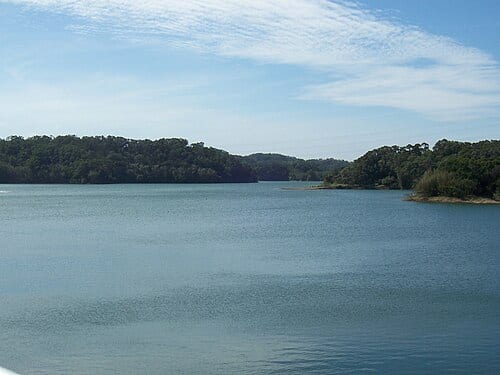
Sanwan Yonghe Mountain Reservoir is an earthfill dam reservoir on the border of Toufen and Sanwan Townships in Miaoli County, built between 1980 and 1984, with a dam height of 89.5 meters and a crest length of 340 meters, holding more than 30 million cubic meters of water. It was Taiwan's first reservoir built without floodgates or sluice gates. The dam crest offers broad views overlooking the reservoir's forested basin and water surface, with hiking trails in the surrounding hills, making it the largest nature recreation area in Sanwan Township.
Yonghe Mountain Reservoir sits on the border between Toufen City and Sanwan Township, Miaoli County. Construction began in July 1980 and was completed in October 1984; it is a rolled earthfill dam, 89.5 meters high with a crest length of 340 meters and crest width of 12 meters, draining a catchment area of about 4.8 square kilometers, with a total capacity of approximately 30.23 million cubic meters (measured in 2015). The reservoir uses a free-overflow side-channel spillway, making it Taiwan's first reservoir without floodgates or sluice gates; treated water supplies Zhunan, Toufen, Zaoqiao, and the Hsinchu Science Park. Sanwan Township is also known for Oriental Beauty tea (historically called Fanzhuang Oolong, mainly the Chin-shin Dahmo cultivar), harvested around the Dragon Boat Festival in June-July each year.
Highlights of Yonghe Mountain Reservoir
Yonghe Mountain Reservoir is an earthfill dam type; the dam body is wide and solid, and the dam crest is walkable, providing a full panoramic view over the reservoir surface. At full water level, the surface reflects the surrounding mountain ridges, creating a quiet and tranquil landscape — one of the few natural attractions in Sanwan Township capable of accommodating a fairly large number of visitors. The reservoir's catchment area has well-preserved vegetation; secondary forest covers the surrounding hillsides, and trails are set along the slopes for easy hiking.
Sanwan Township is known for tea cultivation, and the hillside tea plantations around Yonghe Mountain are an important part of the local agricultural landscape. The trails near the reservoir pass through tea garden terraces, offering insight into how mountainous terrain is utilized for agriculture in Miaoli. The reservoir is water supply infrastructure; management regulations apply within the catchment zone. Visitors must follow posted signs and must not enter restricted areas, to protect water source safety.
Tips for Making the Most of Your Visit
Practical Information
Getting There & Timing
- Sanwan Township has no train station. Drive or take a taxi from Toufen City. From Provincial Highway 3 (Tai-3 Line), turn toward Sanwan Township and follow signs to Yonghe Mountain Reservoir.
- The dam crest and surrounding trails are generally accessible all day, but some restricted areas have posted notices. Follow all on-site instructions.
- There are no dense dining options nearby. Bring your own water and snacks, or eat in Sanwan town center before heading to the reservoir.
Nearby Connections
- Sanwan Township is an important production area for Oriental Beauty tea. After visiting the reservoir, stop at a township tea shop to buy some — a culturally distinctive local purchase.
- Heading south, you can extend to Nanzhuang Township (about 20 minutes by car) to connect with Saisiyat indigenous culture and Nanzhuang Old Street, forming a half-day itinerary through Miaoli's inland mountain area.
Sources: Public information from Yonghe Mountain Reservoir, Taiwan Water Corporation; local data from Sanwan Township Office.
Frequently Asked Questions
When was Yonghe Mountain Reservoir completed?
Construction began in July 1980 and finished in October 1984; it is a rolled earthfill dam.
How much water does Yonghe Mountain Reservoir hold?
Its total capacity is about 30.23 million cubic meters (measured in 2015), with a catchment area of roughly 4.8 square kilometers.
What makes Yonghe Mountain Reservoir unusual?
It was Taiwan's first reservoir built without floodgates or sluice gates, using a free-overflow side-channel spillway design.
Sources
- 水利署全球資訊網-主要水庫簡介-永和山水庫 — 完工年份、蓄水量等官方數據
- 第三區管理處 永和山水庫 — 壩體規格、動工竣工日期、集水區面積
- 東方美人茶 - 維基百科 — 三灣東方美人茶產區與採收時期