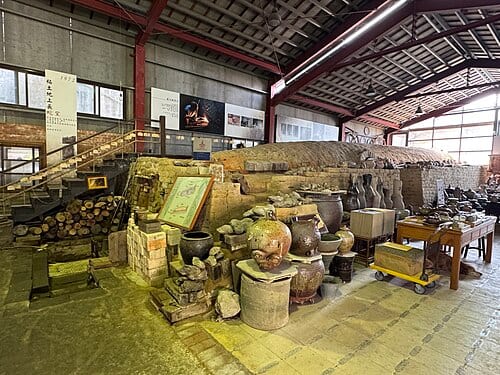
Zhunan Snake Kiln is a traditional wood-fired snake kiln in Zhunan Township, Miaoli County, founded in 1972 by potter Lin Tian-fu. Originally 25 meters long, it has since been shortened to 20 meters and was registered as a Miaoli County historic building in 2002. Snake kilns take their name from their shape — built winding up a hillside like a coiling snake — and the traditional technique of high-temperature wood firing for pottery nearly disappeared after Taiwan's industrialization. This kiln is one of the few remaining examples with an intact structure and historical records, and has since been transformed into a ceramics cultural park.
Zhunan Snake Kiln was founded in 1972 by potter Lin Tian-fu, originally from Waipu, Taichung, who led nine craftsmen and one ox to build it over nine days using hand-molded bricks. Originally 25 meters long, the kiln was later shortened to its current 20 meters because insufficient heat reached the far end of the excessively long flue. It was registered as a Miaoli County historic building on December 25, 2002. Lin (1926–2019) received the Ministry of Culture's Craft Achievement Award in 2016; the kiln stopped firing in 1983 and resumed operation after the Taiwan Provincial Ceramic Arts Association held a wood-firing revival event in 1994.
Highlights of Zhunan Snake Kiln
The snake kiln uses the natural slope of the hillside in its construction; the kiln bed extends from the foot of the slope to the top, and combustion heat flows upward naturally to raise the kiln temperature — a traditional industrial architectural wisdom that adapts to terrain. The Zhunan Snake Kiln has been in existence for over a century; the kiln structure itself is a rare complete industrial relic in Taiwan. The kiln walls, coated with accumulated ceramic waste and flame marks from past firings, constitute a material record of the kiln's long history of use. Ceramics produced in different eras are displayed within the park, allowing visitors to observe the evolution of craft.
The park now offers wheel-throwing experience sessions where visitors can shape clay on a pottery wheel to get a basic feel for the forming process. Kiln-fired pottery tours guide participants into the kiln space, where docents explain the operating principles of a wood-fired kiln and the process of a single firing cycle. The park is moderate in size; a complete visit with experience activity takes about 1.5–2 hours, suitable for travelers interested in craft and industrial heritage.
Tips for Making the Most of Your Visit
Practical Information
Getting There & Timing
- About 20–25 minutes on foot from Zhunan Train Station, or roughly 5 minutes by taxi to the Gongyi Road site.
- The park has specific opening hours and an entrance fee; check the official Zhunan Snake Kiln information for the latest ticket prices and open hours before visiting.
- Experience sessions have limited capacity; book early during long weekends and busy holiday periods.
Nearby Connections
- Pair with the Zhunan Qiding Coast (about 10 minutes by car) for a same-day itinerary, shifting from a craft heritage site to natural coastal scenery.
- Zhunan town has basic dining options; have a meal in town after visiting the kiln before continuing.
Sources: Public records from Zhunan Snake Kiln; cultural heritage information from the Miaoli County Government Bureau of Culture.
Frequently Asked Questions
When was Zhunan Snake Kiln founded?
It was founded in 1972 by potter Lin Tian-fu, who led nine craftsmen and one ox to build it over nine days.
How long is the kiln?
It was originally 25 meters long but was later shortened to its current 20 meters due to insufficient heat at the far end of the flue.
Is Zhunan Snake Kiln a registered cultural heritage site?
Yes, it was registered as a Miaoli County historic building on December 25, 2002.
Sources
- 竹南蛇窯參訪-關於蛇窯(官方網站) — 1972年創立、原長25公尺現截短20公尺、創辦人林添福
- 竹南蛇窯 - 歷史建築 - 國家文化資產網 — 2002年12月25日公告登錄歷史建築
- 林添福 (台灣陶藝家) - 維基百科 — 生平與2016年工藝成就獎