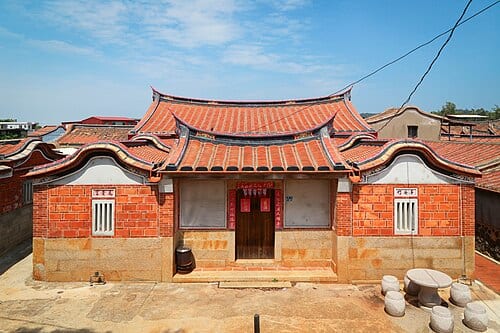
Qionglin Village is a traditional clan settlement in Kinmen with the island's largest concentration of ancestral halls, home to seven halls built by the single-surname Cai clan since the Southern Song dynasty. Beneath the surface, a Cold War-era network of defense tunnels runs throughout, making Qionglin a compound space carrying both clan culture and military history.
Qionglin was founded by Cai Shiqilang in the early Southern Song dynasty, and the entire village bears the single surname Cai. In 1625, Emperor Tianqi of the Ming dynasty bestowed the name "Qionglin" (formerly "Pinglin") in honor of court official and jinshi degree-holder Cai Xianchen. The settlement retains seven ancestral halls in total, and produced six jinshi, six military officers, and seven juren during the Ming and Qing dynasties.
Highlights of Qionglin Village
Qionglin Village is located in the central part of Kinmen Island. Its history can be traced back to the Ming Dynasty, with the Cai clan having lived and flourished here for hundreds of years. The seven ancestral halls are concentrated at the core of the settlement, each with different construction periods and scales, providing a concrete spatial expression of the traditional Minnan clan ritual system. The settlement is now designated as a Kinmen County historical monument group, with its architectural layout well preserved.
Below the ancestral halls and old houses above ground, an extensive defense tunnel system reflects the defensive planning of the Cold War military administration period. The Qionglin Battle Tunnel (listed separately) runs through the underground of the settlement; it was designed to allow all village residents to evacuate during artillery bombardments and serve military deployment purposes. The two layers of historical space coexisting are Qionglin's most distinctive experiential dimension.
Tips for Getting the Most Out of Your Visit
Practical Information
Getting There & Hours
- Qionglin Village is centrally located in Jinhu Township on Kinmen Island. Driving or renting a vehicle is the most convenient way to reach it, a few kilometers from Jinhu Town center.
- The village is an open space. Allow about 1 hour for a walking tour. If visiting the Qionglin Battle Tunnel at the same time, plan for a total of 1.5 to 2 hours.
Nearby Connections
- The Qionglin Battle Tunnel entrance is within the settlement. Combining above-ground and below-ground visits is strongly recommended for a complete Qionglin historical experience.
- The Taiwushan trailhead is within Jinhu Township. Those with enough energy can schedule an afternoon hike there on the same day.
Sources: Kinmen National Park Headquarters; Wikipedia entry on Qionglin Village.
Frequently Asked Questions
Where does the name Qionglin come from?
It was originally named Pinglin; in 1625 the Ming emperor bestowed the name Qionglin in honor of court official and jinshi Cai Xianchen.
How many ancestral halls remain in Qionglin Village?
Seven ancestral halls remain, giving Kinmen's highest concentration of clan halls in one settlement.
How is Qionglin Village connected to the Qionglin Battle Tunnel?
The tunnel entrance is inside the settlement, forming an underground layer beneath the above-ground ancestral hall village.
Sources
- 瓊林蔡氏祠堂-金門縣文化局 — 瓊林蔡氏開基年代、里名由來與七座八祠沿革
- 瓊林聚落-金門觀光旅遊網 — 聚落概況