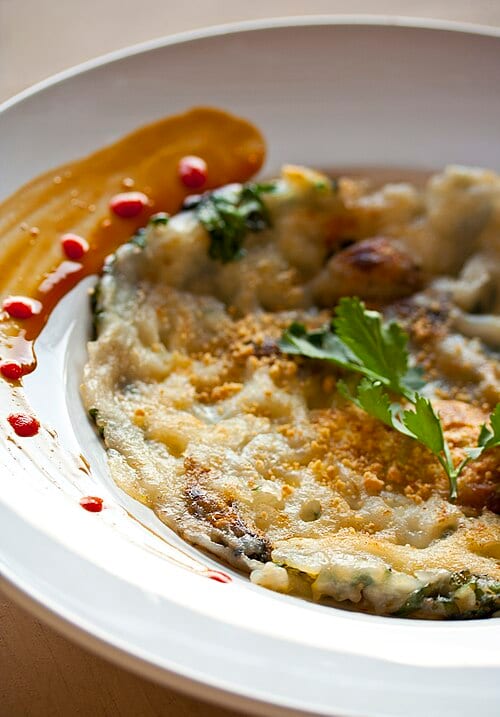
Liuhe oyster omelette is one of the signature street foods at Kaohsiung's Liuhe Tourist Night Market, made by folding fresh oysters into a sweet-potato-starch batter, topping it with egg, and pan-frying it until just set before finishing with sweet chili or haishanjang sauce. Stalls have clustered here since the early 1950s; the market gained official vendor-zone approval from the city government in 1962 and turned into a designated pedestrian night market in 1987, when oyster omelette became its signature draw. The crisp, lightly charred exterior and soft, chewy interior make it one of Taiwan's most iconic night market dishes.
Stalls began gathering in Kaohsiung's Dagangpu area in the early 1950s. In 1962, the city government officially approved a temporary vendor zone, and in 1987 it designated a nighttime pedestrian area with vehicle restrictions, marking the market's shift into a full tourist night market — a transition during which oyster omelette became one of its representative dishes.
What is a Liuhe oyster omelette
Oyster omelette is made by mixing sweet potato starch with water into a batter. Fresh oysters go into the hot oiled pan first, then the batter is poured in and stirred until parts of it develop a light char. An egg is cracked in, briefly mixed, and tender greens — napa cabbage or garland chrysanthemum — are added. The whole thing is cooked until the exterior sets, then plated. Kaohsiung-style fresh oysters are mostly sourced from oyster farms off the coast of Chiayi or Tainan, with full, plump shells and a pronounced salty freshness. The high turnover at Liuhe's stalls means large quantities of oysters come and go quickly, giving ingredients a freshness advantage over quieter night markets. Sweet chili sauce is the dominant accompaniment; some stalls also offer haishanjang.
Liuhe Tourist Night Market was established in 1986 as a planned tourist night market by the Kaohsiung City Government. Located next to the Zhongshan Road shopping district, its prime location and high visibility have made it Kaohsiung's primary food destination for visitors. The sheer number of oyster omelette stalls and the competition among them has created a basic floor of quality that each stall must meet. Kaohsiung oyster omelette draws from oyster supply chains spanning both Chiayi and Kaohsiung harbors — not locally harvested, but fresh deliveries daily. It is one of the defining venues for understanding Taiwan's night market oyster omelette culture.
How to eat it like a local
Local knowledge
Verified context
- Liuhe Tourist Night Market was established in 1986 as a planned tourist night market by the Kaohsiung City Government and is Kaohsiung's most well-known night market food venue.
- Fresh oysters used in Kaohsiung oyster omelettes are mainly sourced from oyster farms off the coast of Chiayi and Tainan, delivered daily to meet the demand of Liuhe's various stalls.
- Competition among oyster omelette stalls at Liuhe is fierce, creating a quality competition mechanism that maintains standards — it is a suitable entry point for first-time visitors wanting to understand Taiwan's night market oyster omelette.
Things to know before you go
- Liuhe Night Market is within a five-minute walk of Kaohsiung MRT Central Park Station — very convenient. Taking public transport is recommended to avoid parking issues.
- Liuhe Night Market is highly tourist-oriented overall; some stalls charge more than other Kaohsiung night markets. Ask or compare neighboring stalls before spending.
- Seating is limited during peak hours (Friday–Sunday, 8–10 p.m.). Consider taking your food to a nearby plaza to eat, or visit on a weekday.
Source: field records from Liuhe Tourist Night Market, Kaohsiung City Tourism Bureau materials.
Frequently Asked Questions
When did Liuhe Night Market first form?
Food stalls began clustering in Kaohsiung's Dagangpu area as early as the early 1950s, and the city government officially approved a temporary vendor zone there in 1962.
When did Liuhe become a tourist night market?
In 1987 the Kaohsiung city government designated a nighttime pedestrian zone with vehicle restrictions, marking the market's shift into a tourist destination.
How should you eat Liuhe oyster omelette like a local?
Ask for a half-cooked egg, choose a stall with a generous oyster count, and drizzle the sauce around the plate edge rather than over the top so you can taste the crisp char.
Sources
- 六合夜市 - 維基百科 — 六合夜市成立與觀光化歷史沿革(1950年代初形成、1962年攤販集中場核准、1987年夜間徒步區)